
The rates of substitution for the following reaction vary with L in the order 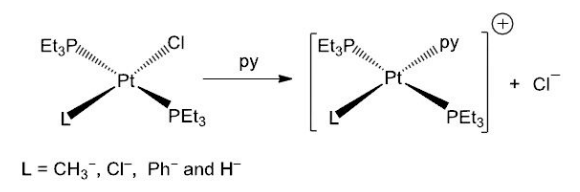
The reaction shown involves the substitution of a group \(L\) on a platinum complex. The relative rates of substitution depend on the nature of \(L\).
The leaving ability is influenced by the stability of the leaving group after it departs. Here, we need to evaluate the order of substitution rates based on the nucleophilicity and stability of various leaving groups: \(CH_3^-, Cl^-, Ph^-,\) and \(H^-\).
- \(H^-\ (Hydride)\): Typically, hydride ions are excellent leaving groups due to their small size and high charge density, making them highly reactive.
- \(CH_3^-\ (Methyl)\): The methyl group has significantly less charge dispersal compared to a hydride, making it a weaker leaving group compared to hydride but better than phenyl or chloride in terms of nucleophilicity.
- \(Ph^-\ (Phenyl)\): The phenyl group is more stable due to resonance, which typically makes it more stable than methyl in leaving terms, but its nucleophilicity is comparably lower to methyl due to delocalization of electrons.
- \(Cl^-\ (Chloride)\): Chloride is a very stable ion and thus a poor leaving group in nucleophilic reactions compared to hydride and methyl.
Based on this analysis, the correct order of substitution rates is:
Correct Order: \(H^- > CH_3^- > Ph^- > Cl^-\\)
Thus, the correct answer is: \(H^- > CH_3^- > Ph^- > Cl^-\\)
Important Questions from Coordination Chemistry
An aqueous solution of $Co(ClO_4)_2 \cdot 6H_2O$ is light pink in colour. Addition of conc. HCl results in an intense blue coloured solution due to the formation of a new species. The new species among the following is
[Given: Atomic number of Co = 27]- Among the following, the compound with the lowest CO stretching frequency is
- Identify X in the reaction, $[Pt(NH_3)_4]^{2+} + 2 HCl \rightarrow X$
- Among the following octahedral complexes, the one that has the highest enthalpy of hydration is
Among the given platinum(II) complexes, the one that is thermally the most unstable is


