
An aqueous solution of $Co(ClO_4)_2 \cdot 6H_2O$ is light pink in colour. Addition of conc. HCl results in an intense blue coloured solution due to the formation of a new species. The new species among the following is
[Given: Atomic number of Co = 27]
$[CoCl_4]^{2-}$
Solution:
Step 1: Initial complex in water
In aqueous solution, cobalt (II) forms the hexaaqua complex:
[Co(H2O)6]2+
This complex has an octahedral structure and appears pink in colour.
Step 2: Effect of concentrated HCl
Concentrated HCl provides a high concentration of Cl− ions. These chloride ions replace water ligands in a ligand substitution reaction.
Step 3: New complex formed
[CoCl4]2−
This complex has a tetrahedral structure and shows an intense blue colour.
Final Answer: [CoCl4]2−
Important Questions from Coordination Chemistry
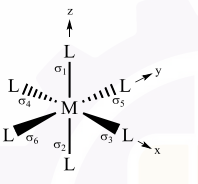
Consider the figure given below, where M is a metal and L is a monodentate ligand. The $\sigma$-bonding ligand group orbital (LGO) having same symmetry with $d_{z^2}$ orbital of M in the octahedral coordination geometry is
- Among the following, the compound with the lowest CO stretching frequency is
- The complex(es) that exhibit(s) optical isomerism is (are)
Among the given platinum(II) complexes, the one that is thermally the most unstable is
- According to Irving-Williams series, the number of d electrons for the first row transition metal (M) ion having the highest overall stability constant (log $\beta$) for $[M(EDTA)]^{2-}$ is ________


