
Consider the figure given below, where M is a metal and L is a monodentate ligand. The $\sigma$-bonding ligand group orbital (LGO) having same symmetry with $d_{z^2}$ orbital of M in the octahedral coordination geometry is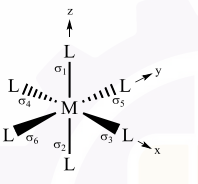
To determine the \(\sigma\)-bonding ligand group orbital (LGO) that has the same symmetry as the \(d_{z^2}\) orbital of an octahedral metal complex, we need to consider the symmetry properties of the orbitals involved.
In an octahedral complex, the \(d_{z^2}\) orbital points directly along the z-axis and aligns with the ligands \(\sigma_1\) and \(\sigma_2\) which are positioned along the z-axis. The symmetry of the \(d_{z^2}\) orbital is such that it is symmetric with respect to the z-axis and has no nodal plane perpendicular to the z-axis.
The correct ligand group orbital will have the greatest contribution from the ligands along the z-axis (\(\sigma_1\) and \(\sigma_2\)) and smaller contributions from the other ligands. Therefore, the correct symmetry adapted linear combination (SALC) of the ligand orbitals should reflect these characteristics. Let's analyze the options:
- \(\frac{1}{\sqrt{12}}(2\sigma_1 + 2\sigma_2 - \sigma_3 - \sigma_4 - \sigma_5 - \sigma_6)\) — This option gives maximum positive weighting to \(\sigma_1\) and \(\sigma_2\), aligning nicely with the character of \(d_{z^2}\).
- \(\frac{1}{\sqrt{12}}(2\sigma_1 - 2\sigma_2 + \sigma_3 - \sigma_4 + \sigma_5 - \sigma_6)\) — This option gives differing weights to \(\sigma_1\) and \(\sigma_2\), which doesn't fit with the symmetrical nature of \(d_{z^2}\).
- \(\frac{1}{\sqrt{6}}(\sigma_1 + \sigma_2 - \sigma_3 - \sigma_4 - \sigma_5 - \sigma_6)\) — This has equal weight for \(\sigma_1\) and \(\sigma_2\), but less significant than the positive weights required.
- \(\frac{1}{\sqrt{6}}(\sigma_1 + \sigma_2 + \sigma_3 + \sigma_4 + \sigma_5 + \sigma_6)\) — This has equal contribution from all ligands, aligning more with the spherically symmetric s-orbital rather than the directional \(d_{z^2}\) orbital.
Thus, the correct answer is:
\(\frac{1}{\sqrt{12}}(2\sigma_1 + 2\sigma_2 - \sigma_3 - \sigma_4 - \sigma_5 - \sigma_6)\)
Important Questions from Coordination Chemistry
- Among the following, the compound with the lowest CO stretching frequency is
- The complex(es) that exhibit(s) optical isomerism is (are)
Among the given platinum(II) complexes, the one that is thermally the most unstable is
- According to Irving-Williams series, the number of d electrons for the first row transition metal (M) ion having the highest overall stability constant (log $\beta$) for $[M(EDTA)]^{2-}$ is ________
- Identify X in the reaction, $[Pt(NH_3)_4]^{2+} + 2 HCl \rightarrow X$


