
In this question, we are asked to determine which given complex(es) exhibit optical isomerism. Optical isomerism occurs when a compound can exist in two non-superimposable mirror images, often due to chirality in coordination complexes. Let's analyze each option:
-
$[Fe(acac)_3]$:
- This is a tris-bidentate complex, where acac (acetylacetonate) acts as a bidentate ligand.
- Such complexes can exhibit chirality if they have an asymmetric coordination environment.
- In this case, $[Fe(acac)_3]$ can form non-superimposable mirror images, and thus, it exhibits optical isomerism.
-
$cis-[Co(en)_2Cl_2]^+$:
- The compound contains two ethylenediamine (en) ligands and two chloride ions in a cis arrangement.
- The presence of chiral centers due to the two bidentate ligands in the cis arrangement causes this to be optically active.
- Hence, $cis-[Co(en)_2Cl_2]^+$ can exhibit optical isomerism.
-
$trans-[Co(en)_2Cl_2]^+$:
- In the trans arrangement, the ligands are symmetrical, creating a plane of symmetry.
- Because of this symmetry, $trans-[Co(en)_2Cl_2]^+$ does not exhibit optical isomerism.
-
$[Co(en)_3]^{3+}$:
- This complex involves three bidentate en ligands forming a symmetrical octahedral complex.
- All ligands being equal and arranged symmetrically allows this complex to have chirality.
- Thus, $[Co(en)_3]^{3+}$ shows optical isomerism.
Based on the above analysis, the complexes that exhibit optical isomerism are $[Fe(acac)_3]$, $cis-[Co(en)_2Cl_2]^+$, and $[Co(en)_3]^{3+}$.
Important Questions from Coordination Chemistry
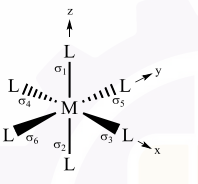
Consider the figure given below, where M is a metal and L is a monodentate ligand. The $\sigma$-bonding ligand group orbital (LGO) having same symmetry with $d_{z^2}$ orbital of M in the octahedral coordination geometry is
- Among the following, the compound with the lowest CO stretching frequency is
Among the given platinum(II) complexes, the one that is thermally the most unstable is
- According to Irving-Williams series, the number of d electrons for the first row transition metal (M) ion having the highest overall stability constant (log $\beta$) for $[M(EDTA)]^{2-}$ is ________
- Identify X in the reaction, $[Pt(NH_3)_4]^{2+} + 2 HCl \rightarrow X$


