
Irving-Williams Series and Transition Metal Stability
The Irving-Williams series outlines the trend in stability constants for complexes formed by divalent first-row transition metal ions (like Mn$^{2+}$ through Zn$^{2+}$).
- Generally, stability increases from Mn$^{2+}$ up to Cu$^{2+}$.
- Stability decreases from Cu$^{2+}$ onwards to Zn$^{2+}$.
- The approximate stability order is: Mn < Fe < Co < Ni < Cu > Zn.
Identifying the Metal Ion with Highest Stability
The question asks for the metal ion (M) in the complex $[M(EDTA)]^{2-}$ that possesses the highest overall stability constant ($\log \beta$). Based on the Irving-Williams series, Copper (Cu$^{2+}$) typically forms the most stable complexes among these ions.
Determining d Electron Count for Cu$^{2+}$
To find the number of d electrons for the relevant ion, we examine the electron configuration of Copper (atomic number 29).
The electron configuration of a neutral Copper atom is: $[Ar] 3d^{10} 4s^1$.
When forming the divalent ion, Cu$^{2+}$, two electrons are removed. The electron is lost first from the 4s orbital, and then from the 3d orbital.
The electron configuration for the Cu$^{2+}$ ion is: $[Ar] 3d^9$.
Therefore, the Cu$^{2+}$ ion contains 9 d electrons.
Important Questions from Coordination Chemistry
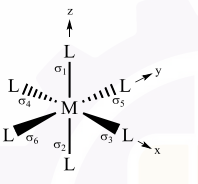
Consider the figure given below, where M is a metal and L is a monodentate ligand. The $\sigma$-bonding ligand group orbital (LGO) having same symmetry with $d_{z^2}$ orbital of M in the octahedral coordination geometry is
- Among the following, the compound with the lowest CO stretching frequency is
- The complex(es) that exhibit(s) optical isomerism is (are)
Among the given platinum(II) complexes, the one that is thermally the most unstable is
- Identify X in the reaction, $[Pt(NH_3)_4]^{2+} + 2 HCl \rightarrow X$


