
Reaction Analysis: Platinum Complex Substitution
The reaction involves the substitution of ligands in a Platinum(II) complex. The starting complex is tetraammineplatinum(II), $[Pt(NH_3)_4]^{2+}$. Hydrochloric acid, HCl, provides chloride ions ($Cl^-$).
Ligand Substitution Process
The reaction is:
$ [Pt(NH_3)_4]^{2+} + 2 HCl \rightarrow X + 2 NH_3 $
- The stoichiometry indicates that two ammine ($NH_3$) ligands are replaced by two chloride ($Cl^-$) ligands.
- The neutral complex formed has the formula $[PtCl_2(NH_3)_2]$.
Determining the Geometric Isomer (X)
The complex $[PtCl_2(NH_3)_2]$ is square planar and can exist as two geometric isomers: cis and trans.
- The formation of the trans isomer is generally favored in this reaction due to the trans effect.
- In $[Pt(NH_3)_4]^{2+}$, all ligands are identical. Upon substitution by the first $Cl^-$, a mono-chloro complex $[PtCl(NH_3)_3]^+$ is formed.
- The second substitution involves an incoming $Cl^-$ replacing an $NH_3$. The existing $Cl^-$ ligand directs the incoming $Cl^-$ to the trans position (as $Cl^-$ has a stronger trans effect than $NH_3$).
- This results in the two chloride ligands being positioned opposite each other (trans).
Therefore, X is trans-$[PtCl_2(NH_3)_2]$.
Conclusion
The product identified as X in the reaction $[Pt(NH_3)_4]^{2+} + 2 HCl$ is trans-$[PtCl_2(NH_3)_2]$.
Important Questions from Coordination Chemistry
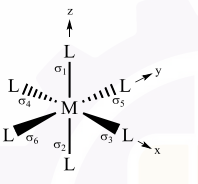
Consider the figure given below, where M is a metal and L is a monodentate ligand. The $\sigma$-bonding ligand group orbital (LGO) having same symmetry with $d_{z^2}$ orbital of M in the octahedral coordination geometry is
- Among the following, the compound with the lowest CO stretching frequency is
- The complex(es) that exhibit(s) optical isomerism is (are)
Among the given platinum(II) complexes, the one that is thermally the most unstable is
- According to Irving-Williams series, the number of d electrons for the first row transition metal (M) ion having the highest overall stability constant (log $\beta$) for $[M(EDTA)]^{2-}$ is ________


