
Hydration Enthalpy: Key Concepts
The enthalpy of hydration measures the energy released when gaseous ions interact with water molecules. A higher (more negative) value indicates stronger interactions.
Hydration Factors for Complexes
For octahedral complexes like these, with a constant charge (+2), the hydration enthalpy depends mainly on the ionic radius of the central metal ion. Smaller ions have higher charge density, leading to stronger hydration.
Comparing Metal Ion Radii
Let's examine the ionic radii (in picometers, pm) for the relevant +2 ions:
- Ca2+: ~100 pm
- V2+: ~78 pm
- Cr2+: ~84 pm
- Mn2+: ~83 pm
The order of ionic radii is: V2+ < Mn2+ < Cr2+ < Ca2+.
Identifying the Highest Hydration Enthalpy
The metal ion with the smallest radius, V2+, possesses the highest charge density.
Therefore, $[V(H_2O)_6]^{2+}$, featuring V2+, exhibits the strongest ion-dipole interactions with water and thus has the highest enthalpy of hydration among the given options.
Important Questions from Coordination Chemistry
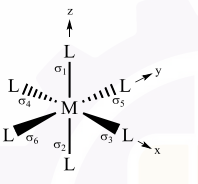
Consider the figure given below, where M is a metal and L is a monodentate ligand. The $\sigma$-bonding ligand group orbital (LGO) having same symmetry with $d_{z^2}$ orbital of M in the octahedral coordination geometry is
- Among the following, the compound with the lowest CO stretching frequency is
- The complex(es) that exhibit(s) optical isomerism is (are)
Among the given platinum(II) complexes, the one that is thermally the most unstable is
- According to Irving-Williams series, the number of d electrons for the first row transition metal (M) ion having the highest overall stability constant (log $\beta$) for $[M(EDTA)]^{2-}$ is ________


