
The rate-determining step in the catalytic synthesis of acetic acid by Monsanto process is
Monsanto Process Overview
The Monsanto process is an industrial method for producing acetic acid by the carbonylation of methanol. This process utilizes a rhodium complex as a homogeneous catalyst.
The overall reaction is:
CH 3 OH + CO → CH 3 COOH
The process proceeds through a catalytic cycle involving several steps. Understanding these steps is crucial to identify the rate-determining one.
Catalytic Cycle Steps
The main steps involved in the rhodium-catalyzed Monsanto process are:
- Formation of methyl iodide (CH3I): Methanol reacts with hydroiodic acid (HI) to form methyl iodide. HI is regenerated later in the cycle.
- Oxidative Addition: Methyl iodide (CH3I) reacts with the Rh(I) catalyst, typically
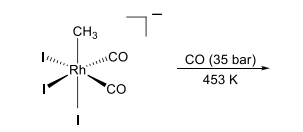
[RhI2(CO)2]−, to form a Rh(III) species,[RhI3(CO)2(CH3)]−. This step involves an increase in the oxidation state of rhodium from +1 to +3. - Migratory Insertion: The methyl group (
CH3) coordinated to rhodium migrates to a coordinated carbonyl ligand (CO), forming an acetyl group (COCH3). This results in the intermediate[RhI3(CO)(COCH3)]−. - CO Coordination: Another carbon monoxide molecule coordinates to the rhodium center, replacing the coordination site freed up during the migratory insertion. This forms
[RhI3(CO)2(COCH3)]−. - Reductive Elimination: Acetyl iodide (
CH3COI) is eliminated from the Rh(III) complex, regenerating the original Rh(I) catalyst,[RhI2(CO)2]−. This step involves a decrease in the oxidation state of rhodium from +3 back to +1. - Hydrolysis: Acetyl iodide reacts with water to produce acetic acid (
CH3COOH) and hydroiodic acid (HI).
Rate-Determining Step Analysis
The rate-determining step is the slowest step in a chemical reaction mechanism, and it dictates the overall reaction rate. In the Monsanto process, kinetic studies have shown that the oxidative addition of methyl iodide (CH3I) to the active rhodium(I) catalyst, [RhI2(CO)2]−, is the slowest step.
Let's look at the options provided:
- Option 1: oxidative addition of CH3I to
[RhI2(CO)2]−- This step involves the breaking of the C-I bond in methyl iodide and the formation of new Rh-C and Rh-I bonds, increasing the oxidation state of Rhodium. This step is known to be relatively slow compared to the other steps in the catalytic cycle. - Option 2: migration of CH3 group to CO of
[RhI3(CO)2(CH3)]−- Migratory insertion steps in such systems are typically fast. - Option 3: loss of CH3COI from
[RhI3(CO)2(COCH3)]−- Reductive elimination of acetyl iodide is generally a relatively fast step, regenerating the catalyst. - Option 4: coordination of CO to
[RhI3CO(COCH3)]−- Ligand coordination steps are usually fast, especially with readily available ligands like CO.
Based on established kinetic data for the Monsanto process, the oxidative addition of methyl iodide is confirmed as the rate-determining step. This step requires breaking a strong bond (C-I) and involves a significant change in the metal's coordination environment and oxidation state, making it the bottleneck in the cycle.
Conclusion
The step that controls the overall speed of the catalytic synthesis of acetic acid by the Monsanto process is the oxidative addition of methyl iodide to the active rhodium(I) catalyst.
Important Questions from Catalysis
The turnover frequency (in $h^{-1}$) of a reaction where 5 mol% of a catalyst is required for 90% conversion in 3 h is ________.
(rounded off to the nearest integer)The elimination product of the following reaction is
In Monsanto acetic acid process shown below, the role of HI is
$CH_3OH + CO \frac{{\text{Rh(I) catalyst / HI}}}{180 °C, 30 bar} CH_3CO_2H$
The homogeneous catalyst whose metal ion does NOT undergo either oxidation or reduction in any of the steps during the hydrogenation of terminal olefins is
- The interconversion of oxidation states of metal(s) observed in Wacker process is(are)


