
In Monsanto acetic acid process shown below, the role of HI is $CH_3OH + CO \frac{{\text{Rh(I) catalyst / HI}}}{180 °C, 30 bar} CH_3CO_2H$
Monsanto Process: Role of HI
The Monsanto acetic acid process synthesizes acetic acid ($CH_3CO_2H$) from methanol ($CH_3OH$) and carbon monoxide ($CO$) using a rhodium catalyst and hydroiodic acid (HI) promoter.
The overall reaction is:
$ CH_3OH + CO \xrightarrow{\text{Rh(I) catalyst / HI}} CH_3CO_2H $The role of HI is critical in initiating the catalytic cycle.
HI's Role in Methanol Conversion
Hydroiodic acid (HI) reacts with methanol ($CH_3OH$) to form methyl iodide ($CH_3I$) and water ($H_2O$). This conversion is essential for the subsequent steps of the catalytic cycle.
The reaction is:
$ CH_3OH + HI \rightarrow CH_3I + H_2O $Methyl iodide ($CH_3I$) is a key intermediate that readily undergoes migratory insertion with carbon monoxide ($CO$) in the presence of the rhodium catalyst, leading to the formation of the acetyl group.
Evaluating the Options
- Option 1: HI does not convert $CH_3OH$ to a stronger nucleophile ($CH_3O^-$). Instead, it protonates $CH_3OH$.
- Option 2: HI is not primarily involved in reducing the Rh(I) catalyst to Rh(0).
- Option 3: While redox changes occur in the cycle, the primary role of HI initiating the cycle involves methyl iodide formation, not direct reduction of Rh(III) to Rh(I).
- Option 4: HI converts $CH_3OH$ to $CH_3I$. This is the crucial first step where methanol is activated for the carbonylation reaction.
Therefore, the primary role of HI in this context is to convert methanol into methyl iodide.
Important Questions from Catalysis
The rate-determining step in the catalytic synthesis of acetic acid by Monsanto process is
The turnover frequency (in $h^{-1}$) of a reaction where 5 mol% of a catalyst is required for 90% conversion in 3 h is ________.
(rounded off to the nearest integer)The elimination product of the following reaction is
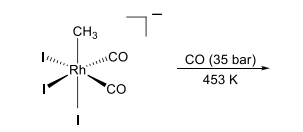
The homogeneous catalyst whose metal ion does NOT undergo either oxidation or reduction in any of the steps during the hydrogenation of terminal olefins is
- The interconversion of oxidation states of metal(s) observed in Wacker process is(are)


