
The elimination product of the following reaction is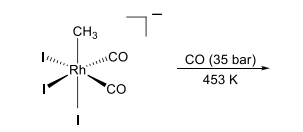
This question involves the analysis of a reaction mechanism to determine the elimination product. Let's break down the problem step-by-step:
- **Identify the Reaction Conditions and Reagents:**
- The reaction given involves carbon monoxide (CO) at 35 bar and a temperature of 453 K.
- The starting complex is a Rhodium complex with iodide (I) and carbonyl (CO) ligands.
- **Understand the Likely Reaction Mechanism:**
- The given conditions suggest a process involving CO insertion or ligand substitution/elimination.
- Rhodium complexes often participate in reactions, such as oxidative addition, reductive elimination, or migratory insertion.
- **Analyze the Potential Products:**
- The elimination process here likely involves replacing or eliminating a ligand from the Rhodium complex.
- Among the options given:
- \(I_2\): Unlikely, as iodine is bonded directly to Rh.
- \(CH_3I\): There is no direct CH3 group that would form this product.
- \(CH_3COI\): Involves the elimination of a single CH3CO group, likely forming by substitution or migration.
- \(I_3^−\): Involves three iodine atoms, which doesn't fit the elimination context here.
- **Conclusion:**
- The most plausible elimination product, considering the CO and reaction conditions, is \(CH_3COI\), where the carbonyl group eliminates as an acyl iodide.
Therefore, the correct answer is \(CH_3COI\).
Important Questions from Catalysis
The rate-determining step in the catalytic synthesis of acetic acid by Monsanto process is
The turnover frequency (in $h^{-1}$) of a reaction where 5 mol% of a catalyst is required for 90% conversion in 3 h is ________.
(rounded off to the nearest integer)In Monsanto acetic acid process shown below, the role of HI is
$CH_3OH + CO \frac{{\text{Rh(I) catalyst / HI}}}{180 °C, 30 bar} CH_3CO_2H$
The homogeneous catalyst whose metal ion does NOT undergo either oxidation or reduction in any of the steps during the hydrogenation of terminal olefins is
- The interconversion of oxidation states of metal(s) observed in Wacker process is(are)


