
Wacker Process: Metal Oxidation State Interconversion
The Wacker process involves the oxidation of ethylene to acetaldehyde using palladium and copper salts as catalysts. This process relies on the reversible redox cycling of these metal ions.
Catalyst Redox Cycles
- Palladium (Pd): The primary catalytic cycle involves palladium changing oxidation states between +2 and 0.
- Pd$^{\text{II}}$ is the active oxidant, accepting electrons from ethylene and being reduced to Pd$^{\text{0}}$.
- The Pd$^{\text{0}}$ intermediate is then re-oxidized back to Pd$^{\text{II}}$ by the copper co-catalyst.
- Copper (Cu): Copper acts as a redox mediator to regenerate the Pd$^{\text{II}}$ state.
- Cu$^{\text{II}}$ oxidizes Pd$^{\text{0}}$ to Pd$^{\text{II}}$, getting reduced to Cu$^{\text{I}}$ in the process.
- Cu$^{\text{I}}$ is subsequently re-oxidized to Cu$^{\text{II}}$ by molecular oxygen (O$_2$).
Observed Interconversions
Based on the mechanism:
- The transition Pd$^{\text{II}}$ $\rightarrow$ Pd$^{\text{0}}$ is a key step.
- The transition Cu$^{\text{II}}$ $\rightarrow$ Cu$^{\text{I}}$ is crucial for regenerating the palladium catalyst.
Therefore, the oxidation state interconversions observed in the Wacker process are Pd(II) / Pd(0) and Cu(II) / Cu(I).
Important Questions from Catalysis
The rate-determining step in the catalytic synthesis of acetic acid by Monsanto process is
The turnover frequency (in $h^{-1}$) of a reaction where 5 mol% of a catalyst is required for 90% conversion in 3 h is ________.
(rounded off to the nearest integer)The elimination product of the following reaction is
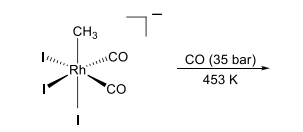
In Monsanto acetic acid process shown below, the role of HI is
$CH_3OH + CO \frac{{\text{Rh(I) catalyst / HI}}}{180 °C, 30 bar} CH_3CO_2H$
The homogeneous catalyst whose metal ion does NOT undergo either oxidation or reduction in any of the steps during the hydrogenation of terminal olefins is


