
The homogeneous catalyst whose metal ion does NOT undergo either oxidation or reduction in any of the steps during the hydrogenation of terminal olefins is
Solution: Homogeneous Catalyst Oxidation State in Olefin Hydrogenation
This question asks to identify a homogeneous catalyst for the hydrogenation of terminal olefins where the central metal ion maintains a constant oxidation state throughout the catalytic cycle. This means the metal does not get oxidized or reduced.
Catalyst Oxidation State Analysis
We need to examine the typical catalytic behavior and the oxidation states of the metal ions in the given options:
-
Option 1: $RhCl(PPh_3)_3$ (Wilkinson's Catalyst)
- The metal is Rhodium (Rh), typically in the +1 oxidation state (Rh(I)).
- Standard hydrogenation mechanisms for Wilkinson's catalyst often involve oxidative addition of H$_2$ to Rh(I), forming a Rh(III) intermediate, followed by reductive elimination. Thus, the Rh oxidation state changes.
-
Option 2: $HRuCl(PPh_3)_3$
- The metal is Ruthenium (Ru), typically in the +2 oxidation state (Ru(II)).
- Certain catalytic hydrogenation mechanisms involving Ru(II) complexes can operate without changing the metal's oxidation state. These mechanisms might involve proton and hydride transfers or concerted hydrogen atom transfers, preserving the Ru(II) state.
-
Option 3: $[Ir(COD)(PCy_3)(Py)]^+PF_6^-$
- The metal is Iridium (Ir), typically in the +1 oxidation state (Ir(I)). (COD, PCy$_3$, Py are neutral ligands).
- Iridium-catalyzed hydrogenations often proceed via Ir(I)/Ir(III) redox cycles, similar to Rhodium.
-
Option 4: $[Rh(COD)(PPh_3)_2]^+PF_6^-$
- The metal is Rhodium (Rh), typically in the +1 oxidation state (Rh(I)).
- Like Wilkinson's catalyst, these Rh(I) complexes generally involve oxidation state changes during hydrogenation.
Conclusion on Constant Oxidation State
Based on the analysis of common catalytic cycles:
- Rhodium (Option 1 and 4) and Iridium (Option 3) catalysts in these forms typically involve changes in oxidation states (e.g., M(I) $\leftrightarrow$ M(III)).
- The Ruthenium complex (Option 2), $HRuCl(PPh_3)_3$, is known to facilitate hydrogenation reactions where the Ru(II) oxidation state can be maintained throughout the catalytic process via specific mechanisms.
Therefore, $HRuCl(PPh_3)_3$ is the homogeneous catalyst whose metal ion does NOT undergo oxidation or reduction in typical catalytic hydrogenation steps.
Important Questions from Catalysis
The rate-determining step in the catalytic synthesis of acetic acid by Monsanto process is
The turnover frequency (in $h^{-1}$) of a reaction where 5 mol% of a catalyst is required for 90% conversion in 3 h is ________.
(rounded off to the nearest integer)The elimination product of the following reaction is
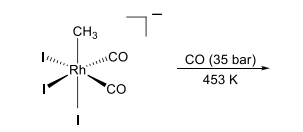
In Monsanto acetic acid process shown below, the role of HI is
$CH_3OH + CO \frac{{\text{Rh(I) catalyst / HI}}}{180 °C, 30 bar} CH_3CO_2H$
- The interconversion of oxidation states of metal(s) observed in Wacker process is(are)


