
The product formed in the following reaction is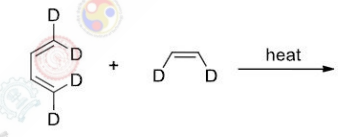
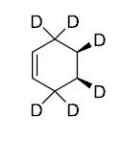
The reaction shown is an example of the Diels-Alder reaction, which is a [4+2] cycloaddition reaction. This type of reaction involves a conjugated diene and a dienophile, resulting in the formation of a cyclic compound.
- In this reaction, the reactants are:
- A deuterated benzene ring with deuterium (D) atoms.
- A dienophile, which is a molecule containing a double bond, in this case, 1,3-butadiene also labeled with deuterium (D).
- The Diels-Alder reaction involves the diene reacting with the dienophile to form a new six-membered ring. The mechanism proceeds with the overlap of the π-orbitals, forming new σ-bonds while breaking existing π-bonds.
- For the given reaction, the deuterated 1,3-butadiene conjugates with the deuterated benzene-like molecule to form a new hexahydro structure containing six carbon atoms and complete with deuterium labeling.
Based on these details, the correct product formed will involve the joining of the two reactants into a new ring structure typically seen in Diels-Alder reactions. This corresponds to the following option:
This product correctly represents the result of the cycloaddition, matching the rearrangement of the original double bonds into a new cyclic structure.
Important Questions from Reaction Mechanisms
Of the following statements regarding dissociative substitution in an octahedral transition metal complex,
(a) High steric hindrance between ligands in the metal complex favors fast dissociation of ligand.
(b) Increased charge on the metal atom/ion of the complex favours the acceptance of electron pair of the entering ligands.
(c) A pentacoordinated intermediate is observed.
(d) Nature of the entering ligand significantly influences the reaction.
Which are correct?
Hydrolysis of the purple isomer of the complex [Co(tren)(NH3)Cl]2+ [tren = Tris(2‐aminoethyl)amine] under basic conditions results in two products. The geometry of the intermediate involved in this reaction is
- The correct statement about base hydrolysis of [Co(py) 4 Cl 2 ]+ (py = pyridine) is
For the given reaction
[*Co(L)n]2+ + [Co(L)n]3+ → [*Co(L)n]3+ + [Co(L)n]2+
the correct statement with respect to the rate of electron transfer process is
o-phen = o-phenanthroline; *Co is labeled atom
The most stable vanadium species in aqueous medium is


