
For the given reaction [*Co(L)n]2+ + [Co(L)n]3+ → [*Co(L)n]3+ + [Co(L)n]2+ the correct statement with respect to the rate of electron transfer process is o-phen = o-phenanthroline; *Co is labeled atom
very slow electron transfer; L = NH3; n = 6
Electron Transfer Rate in Cobalt Complexes
The question concerns the rate of a self-exchange electron transfer reaction involving Cobalt complexes:
\( \text{[*Co(L)n]}^{2+} + \text{[Co(L)n]}^{3+} \rightarrow \text{[*Co(L)n]}^{3+} + \text{[Co(L)n]}^{2+} \)
This type of reaction is a classic example of outer-sphere electron transfer. The rate of such reactions is significantly influenced by factors like the electronic structure of the metal ions in different oxidation states and the ligands.
Factors Affecting Electron Transfer Rate
Key factors influencing the electron transfer rate in metal complexes include:
- Reorganization Energy: This is the energy required to reorganize the nuclear geometry (bond lengths, angles) and the solvent molecules around the complex before the electron transfer can occur. A large change in geometry between the reduced and oxidized forms of the complex leads to a high reorganization energy and a slower rate.
- Spin State Change: If the electron transfer involves a change in the spin state of the metal ion (e.g., high spin to low spin), it can significantly slow down the reaction because it requires a spin flip, which is a quantum mechanically unfavorable process.
- Electronic Coupling: The extent of overlap between the orbitals of the electron donor and acceptor.
Analysis of Ligands and Electron Transfer Rate
Let's consider the two ligands mentioned: $\text{NH}_3$ and o-phenanthroline (o-phen).
Electron Transfer with L = $\text{NH}_3$, n = 6
For \(\text{L} = \text{NH}_3\), which is a weak field ligand, the Cobalt complexes typically exist in the following spin states and electronic configurations (for coordination number 6):
- \(\text{Co(II)} (\text{d}^7)\): Often high spin, configuration \(t_{2g}^5 e_g^2\).
- \(\text{Co(III)} (\text{d}^6)\): With $\text{NH}_3$, Co(III) is typically low spin, configuration \(t_{2g}^6 e_g^0\).
The self-exchange reaction for \(\text{Co(NH}_3)_6^{2+/3+}\) involves the conversion of high-spin Co(II) to low-spin Co(III). This involves a change in both spin state and electronic configuration, particularly in the population of the antibonding \(e_g\) orbitals. High spin \(\text{Co(II)}\) (\(e_g^2\)) has significantly longer Co-N bond lengths compared to low spin \(\text{Co(III)}\) (\(e_g^0\)). This large difference in geometry between the reactant (\(\text{Co(NH}_3)_6^{2+}\)) and product (\(\text{Co(NH}_3)_6^{3+}\)) complexes leads to a very high reorganization energy. Additionally, the spin state change requires a spin flip, which further hinders the electron transfer process.
Therefore, the electron transfer for \(\text{[Co(NH}_3)_6]^{2+/3+}\) is known to be very slow.
Electron Transfer with L = o-phen, n = 3 (tris(o-phen) complex, coordination number 6)
For \(\text{L} = \text{o-phen}\), which is a strong field ligand, the Cobalt complexes typically exist in the following spin states and electronic configurations (for coordination number 6):
- \(\text{Co(II)} (\text{d}^7)\): Often low spin, configuration \(t_{2g}^6 e_g^1\).
- \(\text{Co(III)} (\text{d}^6)\): Low spin, configuration \(t_{2g}^6 e_g^0\).
The self-exchange reaction for \(\text{Co(o-phen)}_3^{2+/3+}\) involves the conversion of low-spin Co(II) to low-spin Co(III). There is no spin state change. The electron transfer involves an electron in the \(e_g\) orbital (\(e_g^1 \rightarrow e_g^0\)). While both are low spin, the removal of an electron from the antibonding \(e_g\) orbital causes a contraction in the Co-ligand bond lengths. This geometry change contributes to the reorganization energy, making the reaction slower compared to systems where only \(t_{2g}\) electrons are transferred (e.g., \(\text{Ru(NH}_3)_6^{2+/3+}\)). However, the absence of a spin state change and the geometry difference typically being less drastic than the high-spin to low-spin transition means this reaction is significantly faster than the \(\text{Co(NH}_3)_6^{2+/3+}\) self-exchange.
This reaction is generally considered slow but not typically described as "very slow" when compared directly to the \(\text{Co(NH}_3)_6^{2+/3+}\) case.
Conclusion
Comparing the two scenarios, the self-exchange electron transfer rate for \(\text{[Co(NH}_3)_6]^{2+/3+}\) is very slow due to the large reorganization energy associated with the significant geometry change and spin state difference between the high-spin Co(II) and low-spin Co(III) complexes. The rate for \(\text{[Co(o-phen)}_3]^{2+/3+}\) is slow but considerably faster than the $\text{NH}_3$ system because both species are low spin, reducing the spin reorganization barrier.
Therefore, the statement that correctly describes the rate with respect to the conditions is "very slow electron transfer; L = $\text{NH}_3$; n = 6".
Important Questions from Reaction Mechanisms
The most stable vanadium species in aqueous medium is
- The correct statement about base hydrolysis of [Co(py) 4 Cl 2 ]+ (py = pyridine) is
Of the following statements regarding dissociative substitution in an octahedral transition metal complex,
(a) High steric hindrance between ligands in the metal complex favors fast dissociation of ligand.
(b) Increased charge on the metal atom/ion of the complex favours the acceptance of electron pair of the entering ligands.
(c) A pentacoordinated intermediate is observed.
(d) Nature of the entering ligand significantly influences the reaction.
Which are correct?
Hydrolysis of the purple isomer of the complex [Co(tren)(NH3)Cl]2+ [tren = Tris(2‐aminoethyl)amine] under basic conditions results in two products. The geometry of the intermediate involved in this reaction is
Consider the following two reactions and their corresponding Hammett plots
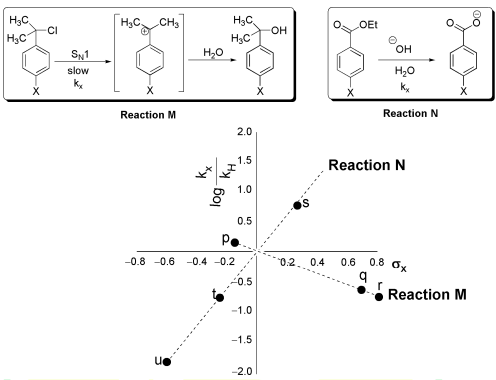
Choose the option(s) that correctly match(es) the points on the graph given in Column-I with substituents X given in Column-II in accordance with their substituents constant $\sigma$
Column-I (points on the graph) Column-II (substituent X) p $NH_2$ q $NO_2$ r $OMe$ s $Cl$ t $Me$ u $CN$


