
Hydrolysis of the purple isomer of the complex [Co(tren)(NH3)Cl]2+ [tren = Tris(2‐aminoethyl)amine] under basic conditions results in two products. The geometry of the intermediate involved in this reaction is
Trigonal bipyramidal
Hydrolysis of Co(tren) Complex
The question asks about the geometry of the intermediate formed during the hydrolysis of the complex $\text{[Co(tren)(NH}_3\text{)Cl]}^{2+}$ under basic conditions. This type of reaction, basic hydrolysis of cobalt(III) complexes, typically proceeds via an $\text{S}_{\text{N}}\text{1cB}$ (conjugate base) mechanism.
Basic Hydrolysis Mechanism (SN1cB)
The $\text{S}_{\text{N}}\text{1cB}$ mechanism involves several steps:
- A proton is removed from a ligand (like $\text{NH}_3$ or an amine proton from tren) coordinated to the metal center, forming a conjugate base intermediate. For example, if a proton is removed from $\text{NH}_3$, it becomes $\text{NH}_2^-$. The equilibrium for this step is often fast.
- The leaving group (in this case, $\text{Cl}^-$) departs from the metal center. This step is usually the rate-determining step and results in a decrease in the coordination number of the metal.
- The nucleophile (water or $\text{OH}^-$) rapidly attacks the electron-deficient metal center to form the product.
The complex $\text{[Co(tren)(NH}_3\text{)Cl]}^{2+}$ is originally a 6-coordinate octahedral complex. When the leaving group $\text{Cl}^-$ departs in the second step of the $\text{S}_{\text{N}}\text{1cB}$ mechanism, a transient species with a coordination number of 5 is formed. This 5-coordinate species is the intermediate referred to in the question.
Geometry of the Intermediate
For transition metal complexes, common geometries for 5-coordinate species are:
- Trigonal bipyramidal (TBP)
- Square pyramidal (SP)
These two geometries are often close in energy and can interconvert rapidly through processes like Berry pseudorotation.
In the context of $\text{S}_{\text{N}}\text{1cB}$ reactions of octahedral complexes, the 5-coordinate intermediate formed after the loss of the leaving group can adopt either trigonal bipyramidal or square pyramidal geometry. Studies on various cobalt(III) complexes undergoing basic hydrolysis via the $\text{S}_{\text{N}}\text{1cB}$ mechanism suggest that the intermediate is often trigonal bipyramidal or square pyramidal, or a geometry somewhere between the two extremes.
Considering the options provided, both trigonal bipyramidal and square pyramidal are plausible geometries for a 5-coordinate intermediate derived from an octahedral complex.
Based on typical reaction pathways for $\text{Co(III)}$ complexes undergoing $\text{S}_{\text{N}}\text{1cB}$ hydrolysis, the trigonal bipyramidal geometry is frequently cited as the geometry of the intermediate or transition state leading to product formation.
Conclusion
The hydrolysis of $\text{[Co(tren)(NH}_3\text{)Cl]}^{2+}$ under basic conditions involves an $\text{S}_{\text{N}}\text{1cB}$ mechanism, leading to a 5-coordinate intermediate after the departure of the chloride ion. The common geometries for 5-coordinate intermediates are trigonal bipyramidal and square pyramidal. Among the given options, Trigonal bipyramidal is a well-established geometry for such intermediates in $\text{Co(III)}$ chemistry.
Important Questions from Reaction Mechanisms
The most stable vanadium species in aqueous medium is
- The correct statement about base hydrolysis of [Co(py) 4 Cl 2 ]+ (py = pyridine) is
For the given reaction
[*Co(L)n]2+ + [Co(L)n]3+ → [*Co(L)n]3+ + [Co(L)n]2+
the correct statement with respect to the rate of electron transfer process is
o-phen = o-phenanthroline; *Co is labeled atom
Of the following statements regarding dissociative substitution in an octahedral transition metal complex,
(a) High steric hindrance between ligands in the metal complex favors fast dissociation of ligand.
(b) Increased charge on the metal atom/ion of the complex favours the acceptance of electron pair of the entering ligands.
(c) A pentacoordinated intermediate is observed.
(d) Nature of the entering ligand significantly influences the reaction.
Which are correct?
Consider the following two reactions and their corresponding Hammett plots
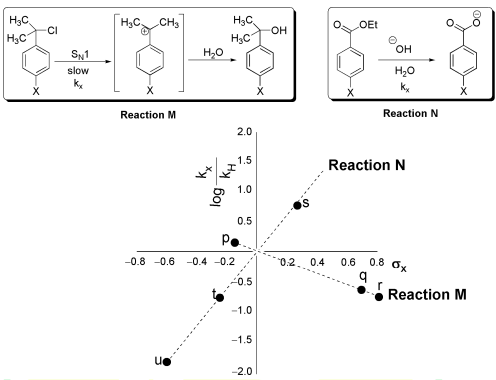
Choose the option(s) that correctly match(es) the points on the graph given in Column-I with substituents X given in Column-II in accordance with their substituents constant $\sigma$
Column-I (points on the graph) Column-II (substituent X) p $NH_2$ q $NO_2$ r $OMe$ s $Cl$ t $Me$ u $CN$


