
Consider the following two reactions and their corresponding Hammett plots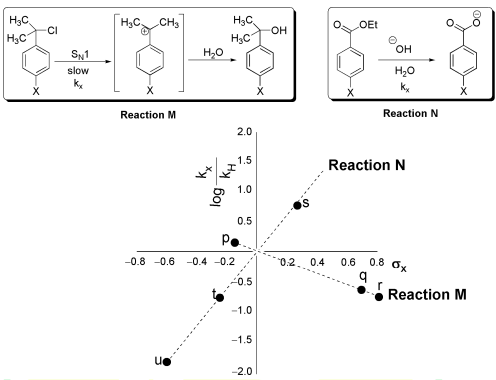
Choose the option(s) that correctly match(es) the points on the graph given in Column-I with substituents X given in Column-II in accordance with their substituents constant $\sigma$
Column-I (points on the graph) Column-II (substituent X) p $NH_2$ q $NO_2$ r $OMe$ s $Cl$ t $Me$ u $CN$
The given problem involves the interpretation of Hammett plots corresponding to Reaction M and Reaction N. The Hammett plot helps us understand the electronic effects of substituents on reaction rates.
In Hammett plots, the substituent constant \sigma indicates whether the substituent is electron-donating or electron-withdrawing. A positive \sigma indicates electron-withdrawing, and a negative \sigma indicates electron-donating properties.
Let's match the points on the graph:
Reaction M:
- u: The point has a negative \sigma value, indicating electron-donating substituents. Hence, it matches with NH_2, which is strongly electron-donating.
- p: It is closer to zero on the negative side, indicating a weak electron-donating substituent. Thus, it matches with Me.
- t: This point has a slightly negative \sigma value than Me, thus correspond with OMe.
Reaction N:
- q: Near the positive \sigma value, indicating strong electron-withdrawing capability, matches with CN.
- r: Even more positive, aligning with a very electron-withdrawing nature, matches with NO_2.
- s: Positive but less than NO_2, matches with moderately electron-withdrawing Cl.
Based on the above reasoning:
- Option 1: Matches with the correct assignment for s, t, u, and r.
- Option 3: Matches with the correct assignment for p, q, r, and t.
Therefore, the correct answers are:
- s \to \sigma(X = Cl); t \to \sigma(X = OMe); u \to \sigma(X = NH_2); r \to \sigma(X = NO_2)
- p \to \sigma(X = Me); q \to \sigma(X = CN); r \to \sigma(X = NO_2); t \to \sigma(X = OMe)
Important Questions from Reaction Mechanisms
The most stable vanadium species in aqueous medium is
- The correct statement about base hydrolysis of [Co(py) 4 Cl 2 ]+ (py = pyridine) is
For the given reaction
[*Co(L)n]2+ + [Co(L)n]3+ → [*Co(L)n]3+ + [Co(L)n]2+
the correct statement with respect to the rate of electron transfer process is
o-phen = o-phenanthroline; *Co is labeled atom
Of the following statements regarding dissociative substitution in an octahedral transition metal complex,
(a) High steric hindrance between ligands in the metal complex favors fast dissociation of ligand.
(b) Increased charge on the metal atom/ion of the complex favours the acceptance of electron pair of the entering ligands.
(c) A pentacoordinated intermediate is observed.
(d) Nature of the entering ligand significantly influences the reaction.
Which are correct?
Hydrolysis of the purple isomer of the complex [Co(tren)(NH3)Cl]2+ [tren = Tris(2‐aminoethyl)amine] under basic conditions results in two products. The geometry of the intermediate involved in this reaction is


