
The process(es) and/or intermediate(s) through which the following transformation proceeds is/are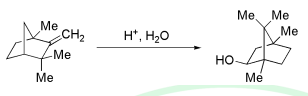
The given transformation involves the conversion of an alkene to an alcohol in an acidic medium. Let’s analyze the intermediates and mechanisms involved in this transformation:
-
Protonation: The first step involves the protonation of the double bond by \( \text{H}^+ \) from the acidic medium, leading to the formation of a more stable carbocation intermediate.
This carbocation is tertiary, because the positively charged carbon is bonded to three other carbon atoms.
-
1,2-Methide Shift: A 1,2-methide shift occurs where a methyl group with its electrons migrates from one carbon to the adjacent carbocation-bearing carbon, stabilizing it further. This step rearranges the structure to form a more stable non-classical ion.
-
Non-Classical Carbocation: The intermediate formed can be a non-classical carbocation, which is a bridged carbocation that shares positive charge over multiple centers, providing additional stabilization.
-
Nucleophilic Attack: Water, a nucleophile, attacks the carbocation, leading to the formation of the alcohol after deprotonation.
The correct intermediates and processes involved in this transformation are:
- 1,2-methide shift
- non-classical carbocation
- tertiary carbocation
These steps demonstrate the mechanistic pathway of converting the given alkene to the corresponding alcohol in acidic conditions.
Important Questions from Reaction Mechanisms
Of the following statements regarding dissociative substitution in an octahedral transition metal complex,
(a) High steric hindrance between ligands in the metal complex favors fast dissociation of ligand.
(b) Increased charge on the metal atom/ion of the complex favours the acceptance of electron pair of the entering ligands.
(c) A pentacoordinated intermediate is observed.
(d) Nature of the entering ligand significantly influences the reaction.
Which are correct?
Hydrolysis of the purple isomer of the complex [Co(tren)(NH3)Cl]2+ [tren = Tris(2‐aminoethyl)amine] under basic conditions results in two products. The geometry of the intermediate involved in this reaction is
- The correct statement about base hydrolysis of [Co(py) 4 Cl 2 ]+ (py = pyridine) is
For the given reaction
[*Co(L)n]2+ + [Co(L)n]3+ → [*Co(L)n]3+ + [Co(L)n]2+
the correct statement with respect to the rate of electron transfer process is
o-phen = o-phenanthroline; *Co is labeled atom
The most stable vanadium species in aqueous medium is


