
The most stable vanadium species in aqueous medium is
Vanadium Stability in Aqueous Solutions
The question asks to identify the most stable vanadium species when dissolved in water (aqueous medium) from the given options.
Vanadium is a transition metal that can exist in several oxidation states, commonly +2, +3, +4, and +5, in aqueous solutions. The stability of these oxidation states depends on various factors, including pH and the presence of oxidizing or reducing agents.
Common Vanadium Species and Oxidation States in Water
Here are some common hydrated or oxo-species of vanadium and their oxidation states:
- Vanadium(II): Vλtex output: 2+ (e.g., λtex output: \( \text{[V(H}_2\text{O)}_6\text{]}^{2+} \)) - Violet, a strong reducing agent.
- Vanadium(III): Vλtex output: 3+ (e.g., λtex output: \( \text{[V(H}_2\text{O)}_6\text{]}^{3+} \)) - Green, also a reducing agent, though weaker than Vλtex output: 2+.
- Vanadium(IV): VOλtex output: 2+ (e.g., λtex output: \( \text{[VO(H}_2\text{O)}_5\text{]}^{2+} \)) - Blue vanadyl ion, relatively stable to redox reactions in air-saturated water.
- Vanadium(V): VOλtex output: \( _2^+ \) (e.g., λtex output: \( \text{[VO}_2\text{(H}_2\text{O)}_4\text{]}^{+} \)) or various vanadates (e.g., λtex output: \( \text{VO}_3^- \)) - Yellow to orange, an oxidizing agent. The species depends heavily on pH.
Analyzing the Given Options
Let's determine the oxidation state of vanadium in each given species:
- λtex output: \( \text{[V(H}_2\text{O)}_5\text{(OH)]}^{2+} \)
- In this complex, Hλtex output: \( _2 \)O is neutral (charge 0) and OHλtex output: \( ^- \) has a charge of -1.
- Let the oxidation state of V be x.
- x + 5(0) + (-1) = +2
- x - 1 = +2
- x = +3
- This species contains Vanadium(III).
- λtex output: \( \text{[VO(H}_2\text{O)}_5\text{]}^{2+} \)
- This complex contains the vanadyl ion, VOλtex output: \( ^{2+} \). In VOλtex output: \( ^{2+} \), the oxygen is typically considered Oλtex output: \( ^{2-} \).
- Let the oxidation state of V be x.
- x + (-2) = +2 (the charge of the VO group)
- x = +4
- This species contains Vanadium(IV) as the hydrated vanadyl ion.
- λtex output: \( \text{[VO(H}_2\text{O)}_5\text{]}^{+} \)
- This complex contains the VOλtex output: \( ^+ \) group. Assuming oxygen is Oλtex output: \( ^{2-} \).
- Let the oxidation state of V be x.
- x + (-2) = +1 (the charge of the VO group)
- x = +3
- This species contains Vanadium(III), possibly as a less common oxo-species or hydrate.
- λtex output: \( \text{[V(H}_2\text{O)}_4\text{(OH)}_2\text{]}^{2+} \)
- In this complex, Hλtex output: \( _2 \)O is neutral (charge 0) and OHλtex output: \( ^- \) has a charge of -1. There are two OHλtex output: \( ^- \) ions.
- Let the oxidation state of V be x.
- x + 4(0) + 2(-1) = +2
- x - 2 = +2
- x = +4
- This species contains Vanadium(IV) as a dihydroxo complex.
Comparing Stability
In aerobic aqueous solutions, Vanadium(II) and Vanadium(III) species are relatively easily oxidized to higher oxidation states. Vanadium(V) species (like VOλtex output: \( _2^+ \)) are oxidizing agents.
Vanadium(IV), primarily existing as the vanadyl ion VOλtex output: \( ^{2+} \), is known to be the most stable oxidation state of vanadium under ambient conditions in a wide pH range in aqueous solution, especially compared to Vλtex output: \( ^{2+} \), Vλtex output: \( ^{3+} \) and Vλtex output: \( ^{5+} \) which are more reactive (reducing or oxidizing).
Among the options provided:
- Options 1 and 3 are Vanadium(III) species, which are less stable against oxidation than V(IV).
- Options 2 and 4 are Vanadium(IV) species. Option 2 is the well-known hydrated vanadyl ion λtex output: \( \text{[VO(H}_2\text{O)}_5\text{]}^{2+} \), which is the predominant and most stable form of V(IV) in aqueous solution. Option 4 is a hydroxo complex of V(IV), likely formed under specific pH conditions and less generally stable than the vanadyl ion itself.
Therefore, the vanadyl ion species, λtex output: \( \text{[VO(H}_2\text{O)}_5\text{]}^{2+} \), is the most stable vanadium species among the given options in aqueous medium.
Conclusion
Based on the stability of vanadium oxidation states and the common species formed in water, the Vanadium(IV) species, specifically the hydrated vanadyl ion, is the most stable. Option 2 represents this species.
Important Questions from Reaction Mechanisms
- The correct statement about base hydrolysis of [Co(py) 4 Cl 2 ]+ (py = pyridine) is
For the given reaction
[*Co(L)n]2+ + [Co(L)n]3+ → [*Co(L)n]3+ + [Co(L)n]2+
the correct statement with respect to the rate of electron transfer process is
o-phen = o-phenanthroline; *Co is labeled atom
Of the following statements regarding dissociative substitution in an octahedral transition metal complex,
(a) High steric hindrance between ligands in the metal complex favors fast dissociation of ligand.
(b) Increased charge on the metal atom/ion of the complex favours the acceptance of electron pair of the entering ligands.
(c) A pentacoordinated intermediate is observed.
(d) Nature of the entering ligand significantly influences the reaction.
Which are correct?
Hydrolysis of the purple isomer of the complex [Co(tren)(NH3)Cl]2+ [tren = Tris(2‐aminoethyl)amine] under basic conditions results in two products. The geometry of the intermediate involved in this reaction is
Consider the following two reactions and their corresponding Hammett plots
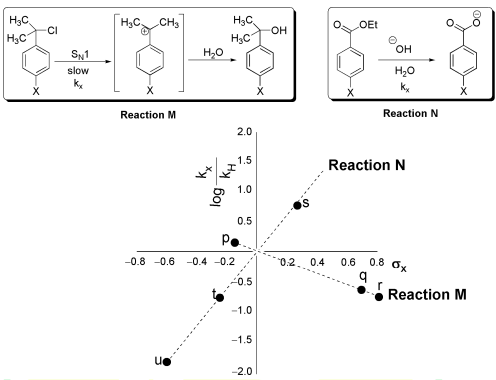
Choose the option(s) that correctly match(es) the points on the graph given in Column-I with substituents X given in Column-II in accordance with their substituents constant $\sigma$
Column-I (points on the graph) Column-II (substituent X) p $NH_2$ q $NO_2$ r $OMe$ s $Cl$ t $Me$ u $CN$


