
Of the following statements regarding dissociative substitution in an octahedral transition metal complex, (a) High steric hindrance between ligands in the metal complex favors fast dissociation of ligand. (b) Increased charge on the metal atom/ion of the complex favours the acceptance of electron pair of the entering ligands. (c) A pentacoordinated intermediate is observed. (d) Nature of the entering ligand significantly influences the reaction. Which are correct?
a and c
Dissociative Substitution in Octahedral Complexes
Dissociative substitution in coordination complexes is a reaction mechanism where the rate-determining step involves the bond breaking between the metal center and a ligand, leading to a decrease in the coordination number of the metal before the entering ligand bonds to the metal.
Let's analyze each statement regarding dissociative substitution in an octahedral transition metal complex:
Statement (a): Steric Hindrance and Dissociation Rate
Statement (a) says that high steric hindrance between ligands favors fast dissociation of a ligand. In an octahedral complex, if the ligands are bulky, there is significant steric repulsion between them. This steric strain weakens the metal-ligand bonds. Breaking a strained bond requires less energy. Therefore, increased steric hindrance makes it easier for a ligand to dissociate from the metal center, thus favoring a faster rate for the dissociative step.
This statement is consistent with the principles of dissociative substitution. High steric hindrance facilitates ligand dissociation.
Statement (b): Metal Charge and Ligand Acceptance
Statement (b) says that increased charge on the metal atom/ion favors the acceptance of the electron pair of the entering ligands. A higher positive charge on the metal makes it more electron-deficient and a stronger Lewis acid, which would indeed favor interaction with an electron-donating entering ligand (a Lewis base). However, in a purely dissociative (D) mechanism, the rate-determining step is the dissociation of the leaving group, which is independent of the entering ligand. The acceptance of the entering ligand occurs *after* the intermediate is formed. Furthermore, a higher positive charge generally strengthens the metal-ligand bond that needs to break in the dissociative step, potentially slowing down the reaction rate.
Therefore, statement (b) is not correct for the rate-determining step of a dissociative mechanism.
Statement (c): Pentacoordinated Intermediate
Statement (c) says that a pentacoordinated intermediate is observed. In the dissociative mechanism (D), the leaving group (L) departs from the octahedral complex $[\text{ML}_6]$, forming a five-coordinate intermediate $[\text{ML}_5]$ and the free leaving group L. The entering ligand ($\text{L}'$) then rapidly attacks the five-coordinate intermediate $[\text{ML}_5]$ to form the product $[\text{ML}_5\text{L}']$.
$[\text{ML}_6] \xrightarrow{\text{slow, -L}} [\text{ML}_5] + \text{L}$ (Rate-determining step)
$[\text{ML}_5] + \text{L}' \xrightarrow{\text{fast}} [\text{ML}_5\text{L}']$
The intermediate $[\text{ML}_5]$ is indeed pentacoordinated (coordination number 5).
This statement is correct regarding the dissociative substitution mechanism.
Statement (d): Influence of Entering Ligand
Statement (d) says that the nature of the entering ligand significantly influences the reaction. In a pure dissociative (D) mechanism, the rate-determining step is the dissociation of the leaving group. The entering ligand ($\text{L}'$) is not involved in this slow step. Its concentration and nature only affect the faster second step where it reacts with the intermediate. Therefore, the rate of a purely dissociative reaction is independent of the nature and concentration of the entering ligand.
This statement is not correct for a pure dissociative substitution mechanism.
Conclusion
Based on the analysis of each statement in the context of dissociative substitution in octahedral transition metal complexes:
- Statement (a) is correct.
- Statement (b) is incorrect.
- Statement (c) is correct.
- Statement (d) is incorrect.
The correct statements are (a) and (c).
Important Questions from Reaction Mechanisms
The most stable vanadium species in aqueous medium is
- The correct statement about base hydrolysis of [Co(py) 4 Cl 2 ]+ (py = pyridine) is
For the given reaction
[*Co(L)n]2+ + [Co(L)n]3+ → [*Co(L)n]3+ + [Co(L)n]2+
the correct statement with respect to the rate of electron transfer process is
o-phen = o-phenanthroline; *Co is labeled atom
Hydrolysis of the purple isomer of the complex [Co(tren)(NH3)Cl]2+ [tren = Tris(2‐aminoethyl)amine] under basic conditions results in two products. The geometry of the intermediate involved in this reaction is
Consider the following two reactions and their corresponding Hammett plots
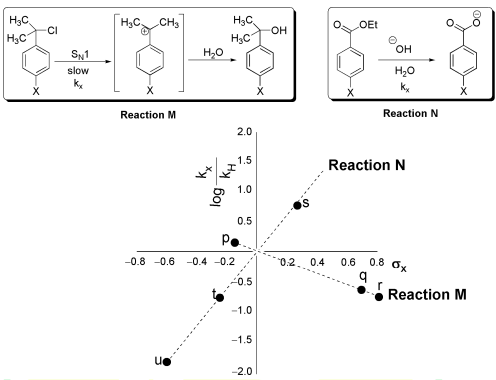
Choose the option(s) that correctly match(es) the points on the graph given in Column-I with substituents X given in Column-II in accordance with their substituents constant $\sigma$
Column-I (points on the graph) Column-II (substituent X) p $NH_2$ q $NO_2$ r $OMe$ s $Cl$ t $Me$ u $CN$


