
The correct statement about base hydrolysis of [Co(py) 4 Cl 2 ]+ (py = pyridine) is
reaction does not depend on hydroxide ion concentration
Base Hydrolysis Reaction Analysis
The question asks about the correct statement regarding the base hydrolysis of the coordination complex $[Co(py)_4Cl_2]^+$ where py represents pyridine.
Base hydrolysis of coordination complexes typically involves the reaction with hydroxide ions. The mechanism can vary depending on the nature of the metal center, the ligands, and the reaction conditions.
Reaction Rate Dependence
One of the key pieces of information to determine the mechanism is the dependence of the reaction rate on the concentration of the reactants, particularly the hydroxide ion concentration in base hydrolysis.
Let's examine the given options:
- Option 1 suggests the rate depends on both the complex concentration and the hydroxide concentration, implying a bimolecular step involving hydroxide.
- Option 2 states the reaction does not depend on hydroxide ion concentration. This is a significant observation. If the rate does not depend on the hydroxide concentration, it means that hydroxide is likely not involved in the rate-determining step of the reaction.
- Option 3 suggests an SN1CB mechanism. This mechanism involves the formation of a conjugate base by deprotonation of a ligand (like NH3 or an amine) by the base (OH−), followed by dissociation of a leaving group from the conjugate base. Pyridine ligands do not have acidic protons readily removable by a base to form a relevant conjugate base for this mechanism.
- Option 4 suggests an associative intermediate where hydroxide adds to the complex. This would typically lead to a rate dependence on hydroxide concentration.
Based on the statement that the reaction does not depend on hydroxide ion concentration (Option 2), the rate-determining step must be unimolecular, involving only the complex itself.
Understanding the Mechanism
When the rate of hydrolysis is independent of the concentration of the attacking nucleophile (in this case, hydroxide), it suggests a dissociative mechanism, similar to the SN1 mechanism in organic chemistry. In such a mechanism, the slow step is the dissociation of a leaving group from the complex:
\( [Co(py)_4Cl_2]^+ \xrightarrow{slow} [Co(py)_4Cl]^{2+} + Cl^- \)
Following this slow dissociation step, the resulting 5-coordinate intermediate reacts rapidly with available nucleophiles, which can be water (in aqueous solution) or hydroxide ions:
\( [Co(py)_4Cl]^{2+} + H_2O \xrightarrow{fast} [Co(py)_4Cl(H_2O)]^{2+} \)
\( [Co(py)_4Cl]^{2+} + OH^- \xrightarrow{fast} [Co(py)_4Cl(OH)]^+ \)
The overall rate expression for a reaction with a rate-determining dissociation step is:
\( Rate = k [Complex] \)
In this case, \( Rate = k [[Co(py)_4Cl_2]^+] \). This rate law is independent of the concentration of hydroxide ion, which aligns with the correct statement.
Therefore, the statement that the reaction does not depend on hydroxide ion concentration indicates a dissociative pathway for the base hydrolysis of $[Co(py)_4Cl_2]^+$.
Conclusion
Analyzing the options and considering the implications of a rate independent of hydroxide concentration, the correct statement is that the reaction does not depend on hydroxide ion concentration, which points towards a dissociative mechanism.
Important Questions from Reaction Mechanisms
The most stable vanadium species in aqueous medium is
For the given reaction
[*Co(L)n]2+ + [Co(L)n]3+ → [*Co(L)n]3+ + [Co(L)n]2+
the correct statement with respect to the rate of electron transfer process is
o-phen = o-phenanthroline; *Co is labeled atom
Of the following statements regarding dissociative substitution in an octahedral transition metal complex,
(a) High steric hindrance between ligands in the metal complex favors fast dissociation of ligand.
(b) Increased charge on the metal atom/ion of the complex favours the acceptance of electron pair of the entering ligands.
(c) A pentacoordinated intermediate is observed.
(d) Nature of the entering ligand significantly influences the reaction.
Which are correct?
Hydrolysis of the purple isomer of the complex [Co(tren)(NH3)Cl]2+ [tren = Tris(2‐aminoethyl)amine] under basic conditions results in two products. The geometry of the intermediate involved in this reaction is
Consider the following two reactions and their corresponding Hammett plots
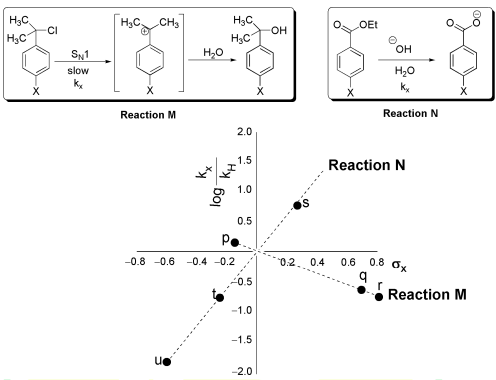
Choose the option(s) that correctly match(es) the points on the graph given in Column-I with substituents X given in Column-II in accordance with their substituents constant $\sigma$
Column-I (points on the graph) Column-II (substituent X) p $NH_2$ q $NO_2$ r $OMe$ s $Cl$ t $Me$ u $CN$


