
The pole-zero configuration of a PI controller is represented by
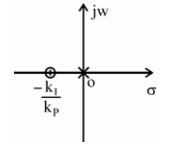
Write the PI transfer function over a common denominator — the pole and zero then read straight off it:
\(G_c(s)=k_P+\dfrac{k_I}{s}=\dfrac{k_Ps+k_I}{s}=k_P\dfrac{\left(s+\dfrac{k_I}{k_P}\right)}{s}\)
The pole comes from the denominator s = 0, i.e. it sits exactly at the origin.
The zero comes from the numerator:
\(s+\dfrac{k_I}{k_P}=0 \Rightarrow s=-\dfrac{k_I}{k_P}\)
so it lies on the negative real axis. That combination — pole at the origin, zero at −kI/kP — is option 3.
Why each feature exists.
The pole at the origin is the integral action. It raises the system type by one, which drives the steady-state error for a step input to zero — the entire reason for using PI control.
The zero on the negative real axis is the proportional action. Its job is to pull the root locus back to the left and so limit the damage the added pole does to stability. Both kP and kI are positive in a stable design, so kI/kP is positive and the zero must be at a negative value of s.
Ruling out the others quickly. Options 1 and 2 place their singularity on the positive real axis: a zero at +kI/kP would make the controller non-minimum-phase, and a pole there would be outright unstable. Option 4 reverses the roles — a zero at the origin would block d.c. entirely (zero gain at zero frequency), the exact opposite of integral action, which needs infinite gain at d.c.
Design note. The zero is usually placed to cancel or nearly cancel the plant's slowest pole; the ratio kI/kP is exactly the reciprocal of the integral time Ti, which is what Ziegler–Nichols tuning sets.
Hence, the PI controller has a zero at –kI/kP and a pole at the origin.
Similar Questions
Consider the following controllers for their system complexity and arrange them in increasing order of complexity.
(A) Proportional controller
(B) Proportional plus derivative controller
(C) Proportional plus integral plus derivative controller
(D) Proportional plus integralChoose the most appropriate answer from the options given below :
Which of the following statement are correct for PI controller?
A. PI controller increases the system type by 1, therefore it improves the steady state error by one order.
B. PI controller reduce the rise time
C. PI controller increase the bandwidth.
D. PI controller is a high pass filter.
E. PI controller adds a pole at S=0 to the forward path transfer function, hence type of system increased by 1.
Choose the most appropriate answer from the options given below :
Match List I with List II
LIST I (Transfer function) LIST II (Controller) A. $\frac{K_{1}S + K_{2} + K_{3}S^{2}}{S}$ I. P-controller B. K1 II. PI-controller C. $\frac{K_1S + K_2}{S}$ III. PD-controller D. K1 + K2S IV. PID - controller Choose the correct answer from the options given below:
The value of Kp in Proportional, PI, PID, controllers are given
A. For proportional Kp = T/L
B. For PI, Kp = 0.9 T/L
C. For PI, Kp = 1.7 T/L
D. For PID, Kp = 1.2 T/L
E. For PID Kp = 0.9 T/L
Choose the correct answer from the options given below:
Read the following statements regarding PID controller :
(a) The system complexity of a PID controller is less than that of a PI controller.
(b) A PID controller produces no action for any constant error signal.
(c) A PID controller is used to increase the damping factor of the dominant poles of a PI controlled system.
(d) A PID controller is used to decrease the damping factor of the dominant poles of a PI controlled system.
Which of the above statements are correct ?
Assertion (A) : A PI controller introduces a pole in the system thereby increasing the order and type of system by one.
Reason (R) : The increase in the type of the system ensures a decrease in the steady state error of the system.
Select your answer using the codes given below.
Important Questions from Controllers
What effect does the proportional parameter of control response have on the rise time in a closed-loop control system?
Which control method is best suitable to eliminate steady state error in closed loop response?
Which of the following is considered as a controller in an automatic toaster system ?
In a feedback control system, the derivative (D) controller has an output proportional to:
A condition where integral control drives the output of a controller into saturation is called ______



