Question
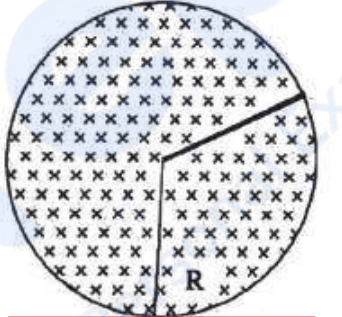
The plot of radial probability density ($4\pi r^{2} R^{2}$) against $r$ for an electron in $np$ orbital of a many electron atom is given below. The value of $n$ is
This question was previously asked in
WBJEE 2026 Physics and Chemistry Question Paper (24-May-2026)
The correct answer is
3
To determine the value of \(n\) for the given radial probability density plot of the \(np\) orbital, we need to understand the characteristic features of these plots. The plot shows the behavior of \(4\pi r^{2} R^{2}\) (radial probability density) against the radial distance \(r\).
Radial Nodes:
- Radial nodes are regions where the probability density is zero.
- The number of radial nodes in an \(np\) orbital is given by \((n - l - 1)\), where \(l\) is the azimuthal quantum number.
- For \(p\) orbitals, \(l = 1\).
The plot shows:
- One radial node (the point where the probability density goes to zero). This indicates:
- For \(np\), the radial nodes = \(n - 1 - 1 = n - 2\).
- Setting the radial nodes to 1, we have \(n - 2 = 1\).
- Solving gives \(n = 3\).
Thus, the value of \(n\) corresponding to this plot of a \(np\) orbital is 3.
Conclusion: The correct answer is 3.
Was this answer helpful?
Similar Questions
- In a conductance experiment, aqueous $\text{AgNO}_{3}$ solution is added to aqueous $\text{KCl}$ solution gradually and simultaneously the molar conductivity ($\lambda_{m}$) is measured. The correct plot of $\lambda_{m}$ versus volume of $\text{AgNO}_{3}$ solution is
- Three engines A, B and C take steam at $130^{\circ}\text{C}$ and reject it at $20^{\circ}\text{C}, 40^{\circ}\text{C}$ and $50^{\circ}\text{C}$ respectively. The most efficient engine will be
- The van't Hoff Factor ($i$) for a dilute aqueous solution of $\text{Na}_{2}\text{SO}_{4}$ is
- A compound contains two types of atoms $A$ and $B$. Its crystal structure is a cubic lattice with '$A$' atoms at the corner of the unit cells and '$B$' atoms at the body centres. The simplest formula of the compound will be
- A buffer solution contains $100\text{ ml}$ of $0.01\text{ (M) } CH_3COOH$ and $200\text{ ml}$ of $0.02\text{ (M) } CH_3COONa$. $700\text{ ml}$ of water is added subsequently to the buffer solution. The pH before and after dilution are
[given, $pK_a = 4.74$ ; $\log 2 = 0.301$] - The van der Waal's equation : $\left(P + \frac{a}{4V^2}\right)\left(V - \frac{b}{2}\right) = \frac{RT}{2}$ is valid for
For the reaction $A \rightleftharpoons B$, variation of concentration is plotted against time as shown below.

Which of the following statements is true?- In a first order reaction, the concentration of reactant decreases from $400\text{ moles lit}^{-1}$ to $50\text{ moles lit}^{-1}$ in $7.5 \times 10^3\text{ s}$. The rate constant of the reaction is (approximately)
- The mass of an electron is $9.1 \times 10^{-31}\text{ kg}$. If its K.E. is $3.0 \times 10^{-25}\text{ J}$, its wavelength is (approximately)
- Glucose is added to 1 litre of water to such an extent that $\Delta T_f / K_f$ equals to $\frac{1}{1000}$. The weight of glucose added is
Important Questions from Physical Chemistry
- X and Y are the number of electrons involved, respectively during the oxidation of $\text{I}^-$ to $\text{I}_2$ and $\text{S}^{2-}$ to S by acidified $\text{K}_2\text{Cr}_2\text{O}_7$. The value of X + Y is ______.
- Consider two Group IV metal ions $\text{X}^{2+}$ and $\text{Y}^{2+}$.
A solution containing 0.01 M $\text{X}^{2+}$ and 0.01 M $\text{Y}^{2+}$ is saturated with $\text{H}_2\text{S}$. The pH at which the metal sulphide YS will form as a precipitate is ______. (Nearest integer)
(Given: $\text{K}_{sp}(\text{XS}) = 1 \times 10^{-22}$ at $25^\circ\text{C}$, $\text{K}_{sp}(\text{YS}) = 4 \times 10^{-16}$ at $25^\circ\text{C}$, $[\text{H}_2\text{S}] = 0.1\text{M}$ in solution, $\text{K}_{a1} \times \text{K}_{a2}(\text{H}_2\text{S}) = 1.0 \times 10^{-21}$, $\log 2 = 0.30$, $\log 3 = 0.48$, $\log 5 = 0.70$) - Electricity is passed through an acidic solution of $\text{Cu}^{2+}$ till all the $\text{Cu}^{2+}$ was exhausted, leading to the deposition of 300 mg of Cu metal. However, a current of 600 mA was continued to pass through the same solution for another 28 minutes by keeping the total volume of the solution fixed at 200 mL. The total volume of oxygen evolved at STP during the entire process is ______ mL. (Nearest integer)
[Given:
$\text{Cu}^{2+}\text{(aq)} + 2\text{e}^- \rightarrow \text{Cu(s)} \quad \text{E}^\circ_{\text{red}} = +0.34 \text{ V}$
$\text{O}_2\text{(g)} + 4\text{H}^+ + 4\text{e}^- \rightarrow 2\text{H}_2\text{O} \quad \text{E}^\circ_{\text{red}} = +1.23 \text{ V}$
Molar mass of Cu = $63.54 \text{ g mol}^{-1}$
Molar mass of $\text{O}_2$ = $32 \text{ g mol}^{-1}$
Faraday Constant = $96500 \text{ C mol}^{-1}$
Molar volume at STP = 22.4 L] - The half-life of ${}^{65}\text{Zn}$ is 245 days. After x days, 75% of original activity remained. The value of $x$ in days is _______. (Nearest integer)
(Given: $\log 3 = 0.4771$ and $\log 2 = 0.3010$) - Molar conductivity of a weak acid HQ of concentration $0.18 \text{ M}$ was found to be $1/30$ of the molar conductivity of another weak acid HZ with concentration of $0.02 \text{ M}$. If $\lambda^\circ_{Q^-}$ happened to be equal with $\lambda^\circ_{Z^-}$, then the difference of the $\text{pK}_a$ values of the two weak acids ($\text{pK}_a\text{(HQ)} - \text{pK}_a\text{(HZ)}$) is _______ (Nearest integer).
[Given: degree of dissociation ($\alpha$) < < 1 for both weak acids, $\lambda^\circ$ : limiting molar conductivity of ions]
Need Expert Advice?
More Questions from WBJEE