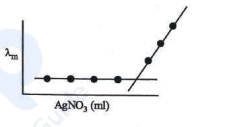
To solve this question, we need to understand the conductometric titration involving the addition of aqueous \(\text{AgNO}_{3}\) to an aqueous \(\text{KCl}\) solution. The reaction involved is:
\(\text{AgNO}_{3(aq)} + \text{KCl}_{(aq)} \rightarrow \text{AgCl}_{(s)} + \text{KNO}_{3(aq)}\)
As silver nitrate (\(\text{AgNO}_{3}\)) is added to potassium chloride (\(\text{KCl}\)), silver chloride (\(\text{AgCl}\)) precipitates, and potassium nitrate (\(\text{KNO}_{3}\)) remains in solution.
- Initially, \(\text{KCl}\) is present in the solution contributing to the initial conductivity due to the mobility of \(\text{K}^{+}\) and \(\text{Cl}^{-}\) ions.
- As \(\text{AgNO}_{3}\) is added, \(\text{Ag}^{+}\) ions react with \(\text{Cl}^{-}\) ions to form the insoluble \(\text{AgCl}\), effectively removing these ions from contributing to conductivity.
- Since \(\text{AgCl}\) is precipitating, the number of free ions decreases, resulting in a decrease in molar conductivity (\(\lambda_{m}\)).
- Upon complete precipitation of \(\text{Cl}^{-}\) ions, the further addition of \(\text{AgNO}_{3}\) leads to an increase in molar conductivity again because now, only \(\text{Ag}^{+}\) and \(\text{NO}_{3}^{-}\) ions are present in the solution, which are good conductors.
Therefore, the correct plot should initially show a decrease in molar conductivity as \(\text{AgNO}_{3}\) is added, followed by a minimum point, and then an increase as the excess \(\text{AgNO}_{3}\) is added.
This corresponds to the correct answer plot, showing the expected behavior during the conductometric titration.
Similar Questions
An electron in the 5d orbital can be represented by the following (n, l, mℓ,) values
Which of the following mixtures act(s) as buffer solution ?
Which statement(s) is/are applicable above critical temperature ?
63 g of a compound (Mol. Wt. = 126) was dissolved in 500 g distilled water. The density of the resultant solution as 1.126 g/ml. The molarity of the solution is
Case – 1: An ideal gas of molecular weight M at temperature T.
Case – 2: Another ideal gas of molecular weight 2M at temperature T/2.
Identify the correct statement in context of above two cases.
A solution containing 4g of polymer in 4.0 litre solution at 27°C shows an osmotic pressure of 3.0×10⁻⁴ atm. The molar mass of the polymer in g/mol is
If in case of a radio isotope the value of half-life (T1/2) and decay constant (λ) are identical in magnitude, then their value should be
At STP, the dissociation reaction of water is H2O ⇌ H+ (aq.) + OH− (aq.) , and the pH of water is 7.0. The change of standard free energy (ΔG°) for the above dissociation process is given by
The equivalent weight of KIO3 in the given reaction is (M = molecular mass):
2Cr(OH)3 + 4OH− + KIO3 → 2CrO42− + 5H2O + KI
For the reaction A + B → C, we have the following data :
Initial concentration of A (in molarity) Initial concentration of B (in molarity) Rate (initial) (Relevant unit) 1 10 100 1 1 1 10 1 10 The order of the reaction with respect to A and B are
Important Questions from Physical Chemistry
- Consider two Group IV metal ions $\text{X}^{2+}$ and $\text{Y}^{2+}$.
A solution containing 0.01 M $\text{X}^{2+}$ and 0.01 M $\text{Y}^{2+}$ is saturated with $\text{H}_2\text{S}$. The pH at which the metal sulphide YS will form as a precipitate is ______. (Nearest integer)
(Given: $\text{K}_{sp}(\text{XS}) = 1 \times 10^{-22}$ at $25^\circ\text{C}$, $\text{K}_{sp}(\text{YS}) = 4 \times 10^{-16}$ at $25^\circ\text{C}$, $[\text{H}_2\text{S}] = 0.1\text{M}$ in solution, $\text{K}_{a1} \times \text{K}_{a2}(\text{H}_2\text{S}) = 1.0 \times 10^{-21}$, $\log 2 = 0.30$, $\log 3 = 0.48$, $\log 5 = 0.70$) - The half-life of ${}^{65}\text{Zn}$ is 245 days. After x days, 75% of original activity remained. The value of $x$ in days is _______. (Nearest integer)
(Given: $\log 3 = 0.4771$ and $\log 2 = 0.3010$) - Molar conductivity of a weak acid HQ of concentration $0.18 \text{ M}$ was found to be $1/30$ of the molar conductivity of another weak acid HZ with concentration of $0.02 \text{ M}$. If $\lambda^\circ_{Q^-}$ happened to be equal with $\lambda^\circ_{Z^-}$, then the difference of the $\text{pK}_a$ values of the two weak acids ($\text{pK}_a\text{(HQ)} - \text{pK}_a\text{(HZ)}$) is _______ (Nearest integer).
[Given: degree of dissociation ($\alpha$) < < 1 for both weak acids, $\lambda^\circ$ : limiting molar conductivity of ions] - The first and second ionization constants of $\text{H}_2\text{X}$ are $2.5 \times 10^{-8}$ and $1.0 \times 10^{-13}$ respectively. The concentration of $\text{X}^{2-}$ in $0.1\text{ M}$ $\text{H}_2\text{X}$ solution is __________ $\times 10^{-15}\text{ M}$. (Nearest Integer)
- The osmotic pressure of a living cell is $12\text{ atm}$ at $300\text{ K}$. The strength of sodium chloride solution that is isotonic with the living cell at this temperature is __________ $\text{g L}^{-1}$. (Nearest integer)
Given : $\text{R} = 0.08\text{ L atm K}^{-1}\text{ mol}^{-1}$
Assume complete dissociation of $\text{NaCl}$
(Given : Molar mass of $\text{Na}$ and $\text{Cl}$ are $23$ and $35.5\text{ g mol}^{-1}$ respectively.)