
(Given: Atomic number: Nd = 60; Pm = 61; Ho = 67; Er = 68)
The question requires identifying pairs of lanthanide ions with the same spin multiplicity and orbital angular momentum but different spin-orbit coupling values. This involves first understanding the electronic configurations of the ions and then determining the quantum mechanical values describing them.
Spin multiplicity is determined by the number of unpaired electrons in the ion, calculated as \({2S + 1}\), where \(S\) is the total spin angular momentum. Orbital angular momentum \(L\) is a result of the azimuthal quantum numbers of the unpaired electrons.
The possible values of total angular momentum \(J\) are given by \(L + S\), \(L + S - 1\), ..., \(|L - S|\).
Let's evaluate each pair:
- $Pm^{3+}$: Atomic number for Pm is 61. As a trivalent ion, it loses 3 electrons. Assuming a 4f configuration with 4f4. Spin multiplicity: 5 (since 4 unpaired electrons, S = 2, \({2S + 1 = 5}\)). Orbital momentum: L = 6. Possible J values: 8, 7, 6, 5, 4.
- $Ho^{3+}$: Atomic number for Ho is 67. As a trivalent ion, it loses 3 electrons, resulting in a 4f10 configuration. Spin multiplicity: 5 (S = 2, unpaired electrons create the same multiplicity due to pairing patterns). Orbital momentum: L = 6. Possible J values: 8, 7, 6, 5, 4.
- $Nd^{3+}$: Atomic number for Nd is 60. As a trivalent ion, it loses 3 electrons and becomes 4f3. Spin multiplicity: 4 (S = 1.5, \({2S + 1 = 4}\)). Orbital momentum: L = 6. Possible J values: 8, 7, 6, 5, 4, 3, 2.
- $Er^{3+}$: Atomic number for Er is 68. As a trivalent ion, loses 3 electrons leading to 4f11. Spin multiplicity: 4 (since S = 1.5, \({2S + 1 = 4}\)). Orbital momentum: L = 6. Possible J values: 8, 7, 6, 5, 4, 3, 2.
Thus, the pairs that meet the criteria are:
- $Pm^{3+}$ and $Ho^{3+}$
- $Nd^{3+}$ and $Er^{3+}$
Both pairs share the same spin multiplicity and orbital angular momentum but differ in their \(J\) values. Consequently, the correct answer comprises these two pairs.
Important Questions from Antigen Antibody Reaction
The interaction between an antigen (Ag) and a single-chain antibody (Ab) was studied using Scatchard analysis. The result is shown below.
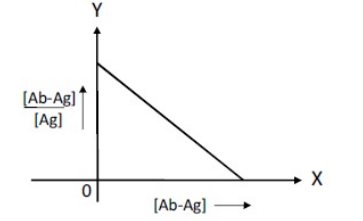
The affinity of interaction and the total concentration of antibody, respectively, can be determined from
Generally, the coordination number and the nature of the electronic absorption band ($f\rightarrow f$transition) of lanthanide (III) ion in their complexes are, respectively,
- The calculated and observed magnetic moments differ considerably for an aqua complex of a lanthanide(III) ion as a result of low lying states of high J. The ion, among the following, is
- The correct electronic configuration and spin only magnetic moment of $Gd^{3+}$ (at.no. 64) are
- If a denatured protein of human origin is injected into a rabbit, antibodies generated will recognize the __________ structure of the protein.


