
Lanthanide Magnetic Moment Discrepancy
The difference between calculated and observed magnetic moments in lanthanide(III) aqua complexes can arise from the influence of low-lying excited states.
Mechanism of Magnetic Moment Deviation
Theoretical magnetic moments are often calculated based on the ground state J-level. However, at ambient temperatures:
- If excited J-levels are energetically close to the ground state, thermal energy can populate them.
- These excited states possess their own magnetic moments.
- The observed magnetic moment reflects an average contribution from the ground state and these populated excited states, leading to deviations from the ground-state-only prediction.
Case of $Eu^{3+}$
The Europium(III) ion, $Eu^{3+}$ (configuration: $[Xe] 4f^6$), is a prime example:
- Ground State ($J=0$): Its ground state is ${}^7F_0$, with $J=0$. A $J=0$ state predicts essentially zero magnetic moment based on first-order calculations.
- Nearby Excited States: Crucially, low-lying excited states like ${}^7F_1$ ($J=1$) and ${}^7F_2$ ($J=2$) are energetically very close (approx. 350 cm⁻¹ and 1000 cm⁻¹, respectively).
- Observed Value: Due to thermal population of these nearby J-levels, the measured magnetic moment of $Eu^{3+}$ aqua complexes is significantly larger than the theoretical prediction for the $J=0$ ground state.
This phenomenon highlights the importance of considering thermally accessible excited states when interpreting the magnetic properties of certain lanthanide ions like $Eu^{3+}$.
Important Questions from Antigen Antibody Reaction
- The pair(s) of lanthanide ions whose ground state term symbols have same spin multiplicity (2S+1) and orbital angular momentum (L), but different spin-orbit coupling (J) is(are)
(Given: Atomic number: Nd = 60; Pm = 61; Ho = 67; Er = 68) The interaction between an antigen (Ag) and a single-chain antibody (Ab) was studied using Scatchard analysis. The result is shown below.
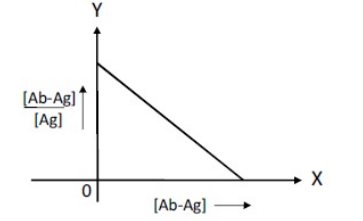
The affinity of interaction and the total concentration of antibody, respectively, can be determined from
Generally, the coordination number and the nature of the electronic absorption band ($f\rightarrow f$transition) of lanthanide (III) ion in their complexes are, respectively,
- The correct electronic configuration and spin only magnetic moment of $Gd^{3+}$ (at.no. 64) are
- If a denatured protein of human origin is injected into a rabbit, antibodies generated will recognize the __________ structure of the protein.


