
Determining Gd3+ Electronic Configuration and Magnetic Moment
Electronic Configuration of Gadolinium (Gd)
Gadolinium (Gd) has atomic number 64. Its ground state electronic configuration is typically written based on the filling order, preceded by the noble gas Xenon (Xe, Z=54). The configuration is: $ Gd: [Xe] 4f^7 5d^1 6s^2 $ Note: Due to the stability of the half-filled $4f$ subshell, this configuration is commonly cited, although variations exist due to close energy levels.
Electronic Configuration of Gd3+ Ion
To find the configuration of the $Gd^{3+}$ ion, we remove three electrons from the neutral Gadolinium atom, starting with the outermost shells (highest principal quantum number 'n', then highest angular momentum 'l').
- Electrons are removed from the $6s$ orbital first (2 electrons).
- Then, one electron is removed from the $5d$ orbital.
Therefore, the electronic configuration of $Gd^{3+}$ is: $ Gd^{3+}: [Xe] 4f^7 $ This configuration features a half-filled $4f$ subshell ($4f^7$), which is particularly stable.
Spin-Only Magnetic Moment Calculation
The spin-only magnetic moment ($\mu_s$) is calculated using the number of unpaired electrons ($n$).
- In the $4f^7$ configuration, all 7 electrons are unpaired according to Hund's rule, occupying separate $f$ orbitals with parallel spins.
- Number of unpaired electrons, $n = 7$.
The formula for the spin-only magnetic moment is: $ \mu_s = \sqrt{n(n+2)} \text{ BM} $ Substituting $n=7$: $ \mu_s = \sqrt{7(7+2)} = \sqrt{7 \times 9} = \sqrt{63} $ $ \mu_s \approx 7.94 \text{ BM} $ This value is approximately 7.9 BM.
Conclusion
The correct electronic configuration for $Gd^{3+}$ is $[Xe]4f^7$, and its spin-only magnetic moment is approximately 7.9 BM. This matches Option 1.
Important Questions from Antigen Antibody Reaction
- The pair(s) of lanthanide ions whose ground state term symbols have same spin multiplicity (2S+1) and orbital angular momentum (L), but different spin-orbit coupling (J) is(are)
(Given: Atomic number: Nd = 60; Pm = 61; Ho = 67; Er = 68) The interaction between an antigen (Ag) and a single-chain antibody (Ab) was studied using Scatchard analysis. The result is shown below.
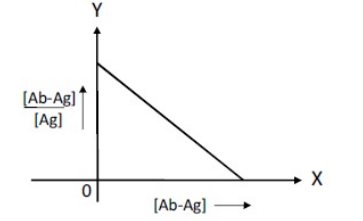
The affinity of interaction and the total concentration of antibody, respectively, can be determined from
Generally, the coordination number and the nature of the electronic absorption band ($f\rightarrow f$transition) of lanthanide (III) ion in their complexes are, respectively,
- The calculated and observed magnetic moments differ considerably for an aqua complex of a lanthanide(III) ion as a result of low lying states of high J. The ion, among the following, is
- If a denatured protein of human origin is injected into a rabbit, antibodies generated will recognize the __________ structure of the protein.


