
Protein Structure Recognition by Antibodies
When a protein is denatured, its complex three-dimensional structure is disrupted. Denaturation specifically affects the secondary, tertiary, and quaternary structures, breaking the hydrogen bonds, ionic bonds, hydrophobic interactions, and disulfide bridges that maintain these higher-order arrangements.
Impact of Denaturation on Protein Structure
The primary structure of a protein, which is the linear sequence of amino acids linked by peptide bonds, remains intact even after denaturation. Denaturation unfolds the protein, potentially exposing different parts of the amino acid chain that were previously hidden within the folded structure.
Antibody Binding Mechanisms
Antibodies are generated by the immune system to recognize specific molecular shapes, known as epitopes, on foreign substances (antigens). When a denatured protein is injected into a rabbit, the rabbit's immune system generates antibodies. Since the protein is in a denatured state, the antibodies produced are primarily directed against the epitopes that are accessible in this unfolded form.
Identifying Recognized Structure
Given that denaturation destroys the secondary, tertiary, and quaternary structures while preserving the primary sequence, the epitopes exposed and recognized by the antibodies generated against the denatured protein will correspond to specific segments of the amino acid sequence. Therefore, the antibodies will recognize the primary structure of the protein.
Important Questions from Antigen Antibody Reaction
- The pair(s) of lanthanide ions whose ground state term symbols have same spin multiplicity (2S+1) and orbital angular momentum (L), but different spin-orbit coupling (J) is(are)
(Given: Atomic number: Nd = 60; Pm = 61; Ho = 67; Er = 68) The interaction between an antigen (Ag) and a single-chain antibody (Ab) was studied using Scatchard analysis. The result is shown below.
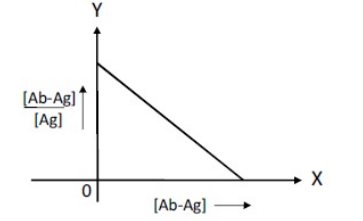
The affinity of interaction and the total concentration of antibody, respectively, can be determined from
Generally, the coordination number and the nature of the electronic absorption band ($f\rightarrow f$transition) of lanthanide (III) ion in their complexes are, respectively,
- The calculated and observed magnetic moments differ considerably for an aqua complex of a lanthanide(III) ion as a result of low lying states of high J. The ion, among the following, is
- The correct electronic configuration and spin only magnetic moment of $Gd^{3+}$ (at.no. 64) are


