
Generally, the coordination number and the nature of the electronic absorption band ($f\rightarrow f$transition) of lanthanide (III) ion in their complexes are, respectively,
Lanthanide Complex Properties Explained
This solution addresses the typical coordination number and the nature of electronic absorption bands ($f\rightarrow f$ transitions) for lanthanide (III) ions in their complexes.
Coordination Number of Lanthanides
Lanthanide ions are relatively large and possess a significant number of available orbitals. This allows them to coordinate with multiple ligands simultaneously. Typically, their coordination numbers exceed 6, often being 7, 8, or even 9 in various complexes. This high coordination capacity is a characteristic feature.
Nature of Lanthanide Electronic Absorption Bands
The electronic absorption bands arising from $f\rightarrow f$ transitions in lanthanide ions exhibit a distinct characteristic:
- Sharpness: These bands are generally sharp and well-defined. This sharpness is attributed to the effective shielding of the 4f electrons by the outer 5s and 5p electron shells. The ligands interact primarily with these outer shells, having minimal influence on the energy levels of the inner 4f orbitals. Consequently, the transitions between these shielded energy levels result in sharp spectral lines, unlike the broader bands seen in d-d transitions of transition metals where d-orbitals are more exposed.
Conclusion on Properties
Combining these observations, the general characteristics are a coordination number greater than 6 and sharp electronic absorption bands due to $f\rightarrow f$ transitions.
Important Questions from Antigen Antibody Reaction
- The pair(s) of lanthanide ions whose ground state term symbols have same spin multiplicity (2S+1) and orbital angular momentum (L), but different spin-orbit coupling (J) is(are)
(Given: Atomic number: Nd = 60; Pm = 61; Ho = 67; Er = 68) The interaction between an antigen (Ag) and a single-chain antibody (Ab) was studied using Scatchard analysis. The result is shown below.
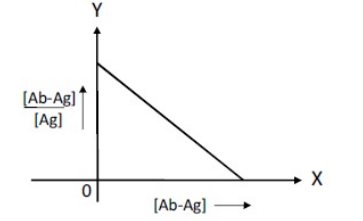
The affinity of interaction and the total concentration of antibody, respectively, can be determined from
- The calculated and observed magnetic moments differ considerably for an aqua complex of a lanthanide(III) ion as a result of low lying states of high J. The ion, among the following, is
- The correct electronic configuration and spin only magnetic moment of $Gd^{3+}$ (at.no. 64) are
- If a denatured protein of human origin is injected into a rabbit, antibodies generated will recognize the __________ structure of the protein.


