The organic compound that displays following data is $^1\text{H}$ NMR ($400\text{ MHz}$): $\delta \ 7.38\text{ (d)}, \ 7.25\text{ (d)}, \ 1.29\text{ (s) ppm}$
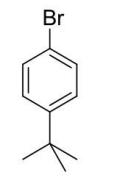
NMR Spectroscopy Analysis
The provided $^1\text{H}$ NMR data shows three distinct signals:
- Two signals in the aromatic region: $δ 7.38 (d)$ and $δ 7.25 (d)$ ppm. The doublet splitting ($d$) suggests adjacent non-equivalent protons, characteristic of aromatic protons in a monosubstituted phenyl ring.
- One signal in the aliphatic region: $δ 1.29 (s)$ ppm. The singlet splitting ($s$) indicates no adjacent non-equivalent protons. The chemical shift is typical for protons in a tert-butyl group.
Structure Elucidation
Combining these observations:
- The aromatic signals ($7.38 ppm (d)$, $7.25 ppm (d)$) strongly suggest the presence of a phenyl group ($C6H5$).
- The aliphatic singlet ($1.29 ppm (s)$) strongly suggests a tert-butyl group ($-C(CH3)3$). The $9$ equivalent methyl protons typically appear as a singlet in this region.
The molecule most consistent with these signals is tert-butylbenzene, which consists of a phenyl ring attached to a tert-butyl group.
Identifying the Correct Option
The structure corresponding to tert-butylbenzene matches the NMR data.
(Assuming Option 1 represents tert-Butylbenzene based on the provided correct answer)
Final Answer: The final answer is $\boxed{A}$
Important Questions from Nmr
- The $^1H$ NMR of mixture of ethyl iodide and bromoform gives three signals at $\delta$ 6.80, 3.20 and 1.85 ppm with integration of 1, 3, 4.5, respectively. The molar ratio of ethyl iodide and bromoform is
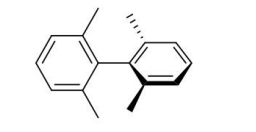
The number of signals observed in the proton decoupled $^{13}\text{C}$ NMR spectrum of the following compound is
The correct match of the circled protons in Column $\text{P}$ with the $^1\text{H}$ NMR chemical shift ($\delta\text{ ppm}$) in Column $\text{Q}$ is
P Q I 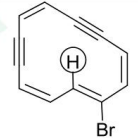
A 6.72 II 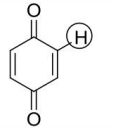
B 16.4 III 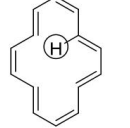
C -0.61 - The ${}^{31}\text{P}\{^1\text{H}\}$ NMR spectrum of $2,2,6,6-\text{N}_4\text{P}_4\text{Cl}_4(\text{NMe}_2)_4$ is expected to show
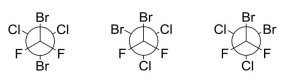
Number of lines in the $^{19}F$ NMR spectrum of $F_2C(Br)-C(Br)Cl_2$ at -120 $^\circ C$ assuming it a mixture of static conformations given below, are