
Number of lines in the $^{19}F$ NMR spectrum of $F_2C(Br)-C(Br)Cl_2$ at -120 $^\circ C$ assuming it a mixture of static conformations given below, are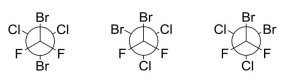
To determine the number of lines in the \(^{19}F\) NMR spectrum of \(F_2C(Br)-C(Br)Cl_2\), we need to analyze the magnetic interactions involving the fluorine atoms in the molecule's different static conformations.
At -120 \(^\circ C\), the molecule is static, implying that the different conformers do not interconvert. In NMR spectra, particularly \(^{19}F\) NMR, each unique chemical environment for a fluorine atom corresponds to a separate resonance line.
- In this molecule, the symmetry and different bromine and chlorine attachments on the carbon atoms influence how the fluorine atoms can couple with neighboring atomic nuclei.
- The fluorine atoms are in different magnetic environments because of their proximity to different halogens (Br and Cl) due to the frozen conformation.
- Considering the presence of multiple halogens, different conformers could lead to different splitting patterns in the NMR spectrum.
By examining the static conformations:
- Each fluorine is coupled with the adjacent bromine, and potentially other fluorines, leading to splitting patterns.
- Different spatial arrangements due to conformational differences can lead to distinct shifts or splitting patterns.
As the conditions are static, each distinct nuclear environment of the fluorines due to conformational variation results in separate lines, leading to a total of five observable lines in the NMR spectrum.
Thus, the correct answer is five
Important Questions from Nmr
- The $^1H$ NMR of mixture of ethyl iodide and bromoform gives three signals at $\delta$ 6.80, 3.20 and 1.85 ppm with integration of 1, 3, 4.5, respectively. The molar ratio of ethyl iodide and bromoform is
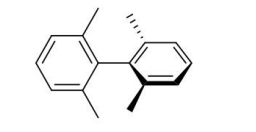
The number of signals observed in the proton decoupled $^{13}\text{C}$ NMR spectrum of the following compound is
The organic compound that displays following data is
$^1\text{H}$ NMR ($400\text{ MHz}$): $\delta \ 7.38\text{ (d)}, \ 7.25\text{ (d)}, \ 1.29\text{ (s) ppm}$
The correct match of the circled protons in Column $\text{P}$ with the $^1\text{H}$ NMR chemical shift ($\delta\text{ ppm}$) in Column $\text{Q}$ is
P Q I 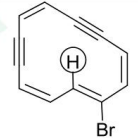
A 6.72 II 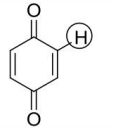
B 16.4 III 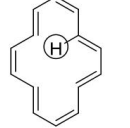
C -0.61 - The ${}^{31}\text{P}\{^1\text{H}\}$ NMR spectrum of $2,2,6,6-\text{N}_4\text{P}_4\text{Cl}_4(\text{NMe}_2)_4$ is expected to show


