NMR Spectrum Analysis: ${}^{31}\text{P}\{^1\text{H}\}$ Decoupled ${}^{31}\text{P}$ NMR
The ${}^{31}\text{P}\{^1\text{H}\}$ NMR experiment involves proton decoupling, meaning any coupling between ${}^{31}\text{P}$ and ${}^1\text{H}$ nuclei is removed. The observed splitting pattern in the ${}^{31}\text{P}$ spectrum arises from coupling between different ${}^{31}\text{P}$ nuclei (P-P coupling).
Molecular Structure and Symmetry
The compound $2,2,6,6-\text{N}_4\text{P}_4\text{Cl}_4(\text{NMe}_2)_4$ typically refers to a phosphazene cage structure containing a $\text{P}_4\text{N}_4$ framework. The formula indicates 4 phosphorus atoms, 4 nitrogen atoms, 4 chlorine substituents, and 4 dimethylamino ($\text{NMe}_2$) substituents distributed among the phosphorus atoms. The numbering ($2,2,6,6$) suggests a high degree of symmetry, leading to distinct sets of chemically equivalent phosphorus atoms.
In symmetrically substituted $\text{P}_4\text{N}_4$ cages, it is common to have two types of chemically equivalent phosphorus atoms. Let's denote these as Type A and Type B. Due to symmetry, there are likely 4 equivalent phosphorus atoms of Type A and 4 equivalent phosphorus atoms of Type B.
Predicting Signal Multiplicity from P-P Coupling
The multiplicity of a signal in NMR depends on the number of equivalent neighboring nuclei it couples to. The number of lines (multiplicity) is given by $2nI + 1$, where $n$ is the number of equivalent neighboring nuclei and $I$ is their nuclear spin ($I = 1/2$ for ${}^{31}\text{P}$).
- Coupling to one equivalent neighboring ${}^{31}\text{P}$ nucleus ($n=1$) results in a doublet (2 lines).
- Coupling to two equivalent neighboring ${}^{31}\text{P}$ nuclei ($n=1$) results in a triplet (3 lines).
Interpreting the Spectrum
For a symmetrical $\text{P}_4\text{N}_4$ cage structure with two distinct sets of phosphorus atoms (Type A and Type B):
- If Type A phosphorus atoms primarily couple to two equivalent Type B phosphorus atoms through the cage framework, the signal for Type A atoms will appear as a triplet.
- Similarly, if Type B phosphorus atoms couple to two equivalent Type A phosphorus atoms, their signal will also appear as a triplet.
Therefore, the ${}^{31}\text{P}\{^1\text{H}\}$ NMR spectrum is expected to show two distinct signals, each appearing as a triplet, corresponding to the two different types of phosphorus atoms in the molecule.
Important Questions from Nmr
- The $^1H$ NMR of mixture of ethyl iodide and bromoform gives three signals at $\delta$ 6.80, 3.20 and 1.85 ppm with integration of 1, 3, 4.5, respectively. The molar ratio of ethyl iodide and bromoform is
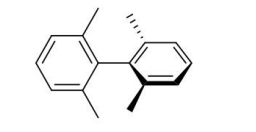
The number of signals observed in the proton decoupled $^{13}\text{C}$ NMR spectrum of the following compound is
The organic compound that displays following data is
$^1\text{H}$ NMR ($400\text{ MHz}$): $\delta \ 7.38\text{ (d)}, \ 7.25\text{ (d)}, \ 1.29\text{ (s) ppm}$
The correct match of the circled protons in Column $\text{P}$ with the $^1\text{H}$ NMR chemical shift ($\delta\text{ ppm}$) in Column $\text{Q}$ is
P Q I 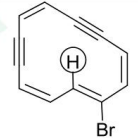
A 6.72 II 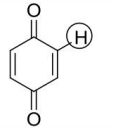
B 16.4 III 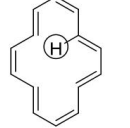
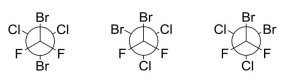
C -0.61 Number of lines in the $^{19}F$ NMR spectrum of $F_2C(Br)-C(Br)Cl_2$ at -120 $^\circ C$ assuming it a mixture of static conformations given below, are