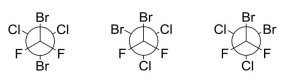
The number of signals observed in the proton decoupled $^{13}\text{C}$ NMR spectrum of the following compound is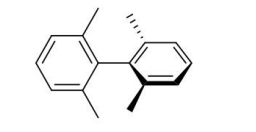
To determine the number of signals observed in the proton-decoupled \(^{13}\text{C}\) NMR spectrum of the given compound, we need to consider the different carbon environments in the structure.
The structure of the compound shows a bicyclic aromatic system with substituents. The number of signals in a \(^{13}\text{C}\) NMR depends on the number of unique carbon environments. Identical carbon atoms (such as those in equivalent positions) will resonate at the same chemical shift, leading to fewer signals than the actual number of carbon atoms.
- The compound contains two aromatic rings. We analyze both rings to determine the distinct carbon environments.
- The isopropyl group on the left affects the symmetry of the phenyl ring, making some positions equivalent. The phenyl ring carbons will have fewer signals due to this symmetry.
- The right ring contains a substituent at one position which disrupts the symmetry, resulting in different chemical environments for each carbon.
- By assigning the different carbon environments, we count each unique carbon signal. After careful analysis based on molecular symmetry and chemical environment, we identify 5 unique carbon environments in the compound.
Thus, the number of signals in the proton-decoupled \(^{13}\text{C}\) NMR spectrum of the compound is five.
The correct answer is: five.
Important Questions from Nmr
- The $^1H$ NMR of mixture of ethyl iodide and bromoform gives three signals at $\delta$ 6.80, 3.20 and 1.85 ppm with integration of 1, 3, 4.5, respectively. The molar ratio of ethyl iodide and bromoform is
The organic compound that displays following data is
$^1\text{H}$ NMR ($400\text{ MHz}$): $\delta \ 7.38\text{ (d)}, \ 7.25\text{ (d)}, \ 1.29\text{ (s) ppm}$
The correct match of the circled protons in Column $\text{P}$ with the $^1\text{H}$ NMR chemical shift ($\delta\text{ ppm}$) in Column $\text{Q}$ is
P Q I 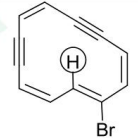
A 6.72 II 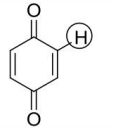
B 16.4 III 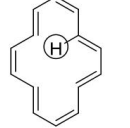
C -0.61 - The ${}^{31}\text{P}\{^1\text{H}\}$ NMR spectrum of $2,2,6,6-\text{N}_4\text{P}_4\text{Cl}_4(\text{NMe}_2)_4$ is expected to show
Number of lines in the $^{19}F$ NMR spectrum of $F_2C(Br)-C(Br)Cl_2$ at -120 $^\circ C$ assuming it a mixture of static conformations given below, are