The number of $sp^3$ and $sp^2$ carbons, respectively, present in the Meisen- heimer complex, formed in the following reaction are 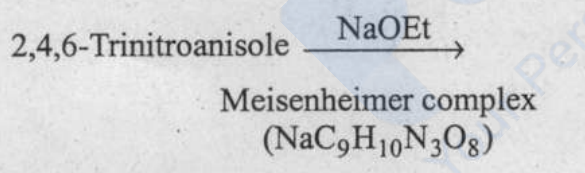
Four and five
The given reaction involves the formation of a Meisenheimer complex from 2,4,6-trinitroanisole using sodium ethoxide (NaOEt) as a base. The structure of the Meisenheimer complex is crucial for determining the hybridization of the carbon atoms within it.
- In the Meisenheimer complex, sp^2 and sp^3 hybridizations will primarily be on the benzene ring and the carbon attached to the methoxy group, respectively.
- The carbon atoms in the benzene ring are typically sp^2 hybridized. Given it's a hexa-substituted benzene ring, we ideally have six sp^2 carbons.
- However, in the formation of the Meisenheimer complex, a nucleophile (in this case, ethoxide) attacks the para position relative to one of the nitro groups, converting one of the carbons into an sp^3 hybridized atom.
- The methoxy group contributes another sp^3 hybridized carbon (the one directly attached to the ether oxygen).
- Therefore, another sp^3 carbon arises due to the methoxy group, giving a total of four sp^3 carbons.
- Hence, this gives us the count of four sp^3 hybridized and five sp^2 hybridized carbon atoms in the complex.
Therefore, the correct answer is: Four sp^3 and five sp^2 carbons respectively.
The correct option is: Four and five.
Important Questions from Aromatic compounds
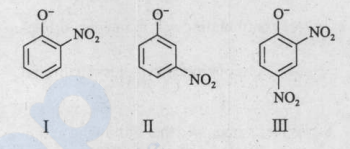
The correct decreasing order of basicity of the following anions is
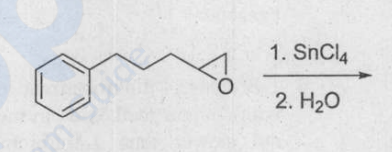
The major product formed in the following reaction sequence is
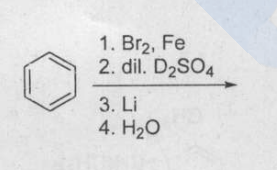
The major product formed in the following reaction is
Consider the following statements :
1. 4-Chloro-3-nitroacetophenone reacts with sodium methoxide in methanol slower than 4-chloro-3- nitrotoluene
2. 4-Chloro-3-nitroacetophenone reacts with sodium methoxide in methanol faster than 4-chloro-3- nitrotoluene
3. 1-Bromo-2,4-dinitrobenzene reacts with sodium methoxide in metha- nol faster than 1,4-dibromo-2-nitro- benzene
4. 1-Bromo-2,4-dinitrobenzene reacts with sodium methoxide in metha- nol slower than 1,4-dibromo-2- nitrobenzeneWhich of the statements given above are correct?
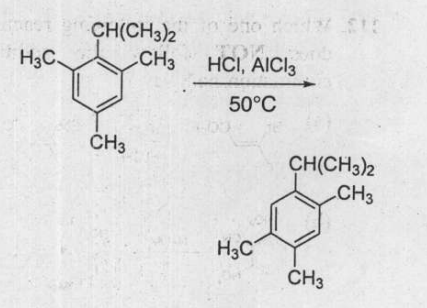
The most reasonable cyclohexadienyl cation intermediate involved in the mechanism of following isomerization reaction is