Consider the following statements : 1. 4-Chloro-3-nitroacetophenone reacts with sodium methoxide in methanol slower than 4-chloro-3- nitrotoluene Which of the statements given above are correct?
2. 4-Chloro-3-nitroacetophenone reacts with sodium methoxide in methanol faster than 4-chloro-3- nitrotoluene
3. 1-Bromo-2,4-dinitrobenzene reacts with sodium methoxide in metha- nol faster than 1,4-dibromo-2-nitro- benzene
4. 1-Bromo-2,4-dinitrobenzene reacts with sodium methoxide in metha- nol slower than 1,4-dibromo-2- nitrobenzene
2 and 3
Understanding Nucleophilic Aromatic Substitution Rates
This question involves understanding the factors that affect the rate of nucleophilic aromatic substitution reactions. The key factors are the presence and position of electron-withdrawing groups (EWGs) and the nature of the leaving group.
Analysis of Statement 1 & 2: Acetophenone vs Toluene Derivatives
These statements compare the reaction rates of:
- 4-chloro-3-nitroacetophenone: Contains a chloro group (leaving group) at C4, a nitro group (strong EWG) at C3, and an acetophenone group (-COCH3) at C1.
- 4-chloro-3-nitrotoluene: Contains a chloro group (leaving group) at C4, a nitro group (strong EWG) at C3, and a methyl group (-CH3) at C1.
Mechanism Consideration: Nucleophilic aromatic substitution is facilitated by EWGs located ortho or para to the leaving group. The acetophenone group (-COCH3) is electron-withdrawing due to the carbonyl group's polarity, which helps stabilize the intermediate (Meisenheimer complex) formed during the reaction. The methyl group (-CH3), on the other hand, is electron-donating. An electron-donating group destabilizes the intermediate and slows down the reaction. Furthermore, the nitro group at C3 helps activate the C4 position (where the chlorine is) for substitution.
Comparison: Because the acetophenone group is electron-withdrawing and activates the ring towards nucleophilic attack more than the electron-donating methyl group, 4-chloro-3-nitroacetophenone reacts faster than 4-chloro-3-nitrotoluene.
Therefore, statement 2 is correct, and statement 1 is incorrect.
Analysis of Statement 3 & 4: Dinitrobenzene Derivatives
These statements compare the reaction rates of:
- 1-bromo-2,4-dinitrobenzene: Contains a bromo group (leaving group) at C1, and two nitro groups (strong EWGs) at C2 and C4.
- 1,4-dibromo-2-nitrobenzene: Contains a bromo group (leaving group) at C1, another bromo group at C4, and a nitro group (strong EWG) at C2.
Mechanism Consideration: The rate of nucleophilic aromatic substitution strongly depends on the activation provided by EWGs, especially those positioned ortho and para to the leaving group. Nitro groups are powerful EWGs.
Comparison:
- In 1-bromo-2,4-dinitrobenzene, the leaving group (Br at C1) has strong activation from nitro groups at both the ortho (C2) and para (C4) positions.
- In 1,4-dibromo-2-nitrobenzene, the leaving group (Br at C1) has activation from a nitro group at the ortho position (C2). The substituent at the para position (C4) is another bromine atom. While bromine has some electron-withdrawing inductive effect, it is much less activating for nucleophilic aromatic substitution compared to a nitro group. Resonance donation from bromine is less significant than the inductive withdrawal in this context relative to a nitro group.
Due to the presence of two strongly activating nitro groups (ortho and para) compared to just one nitro group (ortho) and a less activating bromine atom (para), 1-bromo-2,4-dinitrobenzene reacts faster with sodium methoxide than 1,4-dibromo-2-nitrobenzene.
Therefore, statement 3 is correct, and statement 4 is incorrect.
Conclusion on Correct Statements
Based on the analysis, the correct statements are:
- Statement 2: 4-Chloro-3-nitroacetophenone reacts faster than 4-chloro-3-nitrotoluene.
- Statement 3: 1-Bromo-2,4-dinitrobenzene reacts faster than 1,4-dibromo-2-nitrobenzene.
Thus, the combination of statements 2 and 3 is correct.
Important Questions from Aromatic compounds
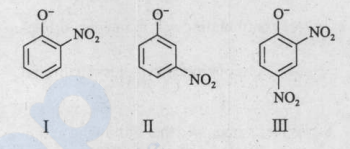
The correct decreasing order of basicity of the following anions is
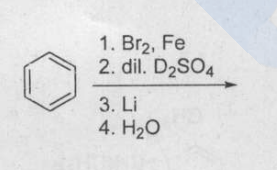
The major product formed in the following reaction sequence is
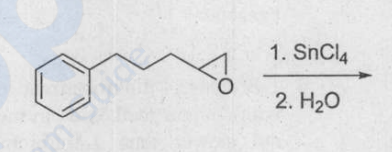
The major product formed in the following reaction is
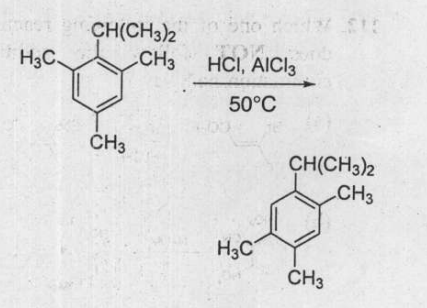
The most reasonable cyclohexadienyl cation intermediate involved in the mechanism of following isomerization reaction is
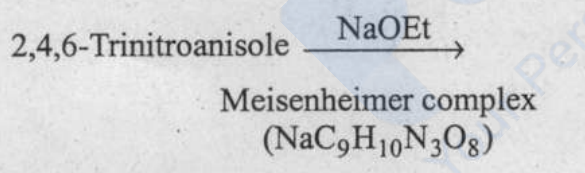
The number of $sp^3$ and $sp^2$ carbons, respectively, present in the Meisen- heimer complex, formed in the following reaction are