The major product formed in the following reaction is 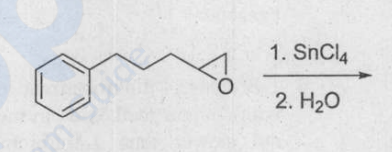
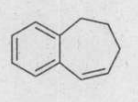
The reaction provided involves the use of SnCl_4 followed by hydrolysis with H_2O. Let's analyze this step-by-step:
-
SnCl4 as a Lewis Acid: SnCl4 is a strong Lewis acid, which can coordinate to the oxygen in the epoxide, increasing the electrophilicity of the carbon atoms in the epoxide ring.
-
Opening of the Epoxide Ring: The presence of the aromatic ring (phenyl group) allows the more substituted carbon to be more stable, favoring the epoxide opening at the less hindered carbon atom.
-
Formation of the Major Product: This leads to the formation of a carbocation at the benzylic position, which is stabilized by resonance with the aromatic ring. Subsequent attack by water leads to the formation of the major product, which is a phenethyl alcohol derivative.
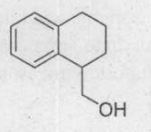
The correct product formed by the given reaction scheme is therefore represented in the above structure, where there is an alcohol group attached to the benzylic carbon. The resonance stabilization makes this the most favorable and stable formation.
Important Questions from Aromatic compounds
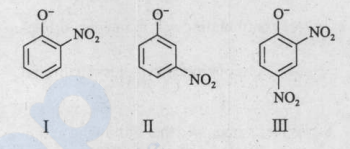
The correct decreasing order of basicity of the following anions is
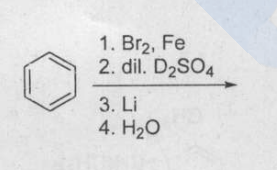
The major product formed in the following reaction sequence is
Consider the following statements :
1. 4-Chloro-3-nitroacetophenone reacts with sodium methoxide in methanol slower than 4-chloro-3- nitrotoluene
2. 4-Chloro-3-nitroacetophenone reacts with sodium methoxide in methanol faster than 4-chloro-3- nitrotoluene
3. 1-Bromo-2,4-dinitrobenzene reacts with sodium methoxide in metha- nol faster than 1,4-dibromo-2-nitro- benzene
4. 1-Bromo-2,4-dinitrobenzene reacts with sodium methoxide in metha- nol slower than 1,4-dibromo-2- nitrobenzeneWhich of the statements given above are correct?
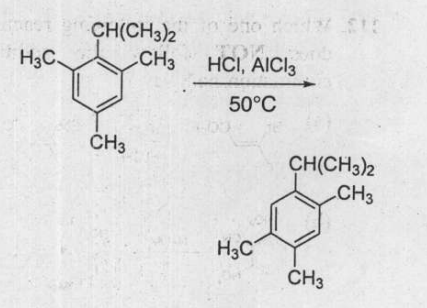
The most reasonable cyclohexadienyl cation intermediate involved in the mechanism of following isomerization reaction is
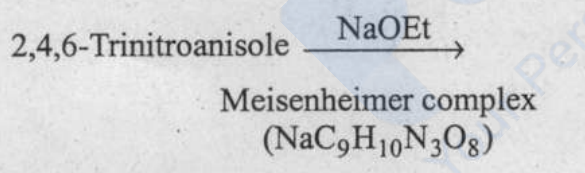
The number of $sp^3$ and $sp^2$ carbons, respectively, present in the Meisen- heimer complex, formed in the following reaction are