The correct decreasing order of basicity of the following anions is 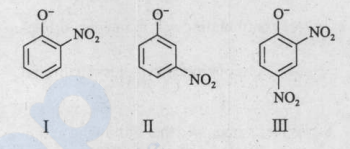
III > I > II
To determine the order of basicity for the given anions, we need to understand how substituents affect the electron density on the oxygen atom bearing the negative charge. The basicity of anions can be influenced by electron-withdrawing or electron-donating groups through inductive and resonance effects.
- Understanding the structures:
- I: Para-nitrophenoxide anion
- II: Meta-nitrophenoxide anion
- III: Ortho-nitrophenoxide anion
- Effect of Nitro Group (-NO2):
- The nitro group is a strong electron-withdrawing group due to its -R (resonance) and -I (inductive) effects.
- The ability of the nitro group to withdraw electrons decreases the electron density on the oxygen atom, thereby reducing the basicity of the anion.
- Relative Position Effects:
- Para position (I): Although there is resonance contribution, the inductive effect is less direct compared to the ortho position.
- Meta position (II): Only the inductive effect operates, which makes it moderately decreasing basicity.
- Ortho position (III): Both inductive and strong resonance effects operate, leading to maximum reduction in electron density and hence lowest basicity.
Based on these analyses, the decreasing order of basicity of the anions is:
I > III > II
The para-nitrophenoxide anion (I) is least affected by the electron-withdrawing effects compared to ortho (III) and meta (II) positions, making it the most basic. Therefore, the correct option is I > III > II.
Important Questions from Aromatic compounds
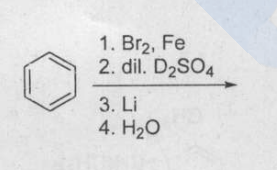
The major product formed in the following reaction sequence is
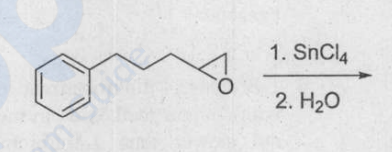
The major product formed in the following reaction is
Consider the following statements :
1. 4-Chloro-3-nitroacetophenone reacts with sodium methoxide in methanol slower than 4-chloro-3- nitrotoluene
2. 4-Chloro-3-nitroacetophenone reacts with sodium methoxide in methanol faster than 4-chloro-3- nitrotoluene
3. 1-Bromo-2,4-dinitrobenzene reacts with sodium methoxide in metha- nol faster than 1,4-dibromo-2-nitro- benzene
4. 1-Bromo-2,4-dinitrobenzene reacts with sodium methoxide in metha- nol slower than 1,4-dibromo-2- nitrobenzeneWhich of the statements given above are correct?
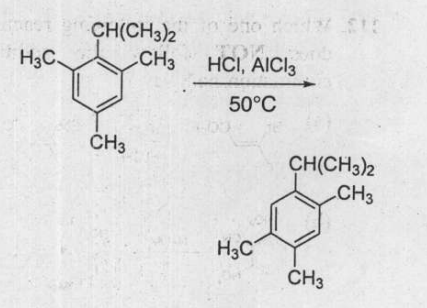
The most reasonable cyclohexadienyl cation intermediate involved in the mechanism of following isomerization reaction is
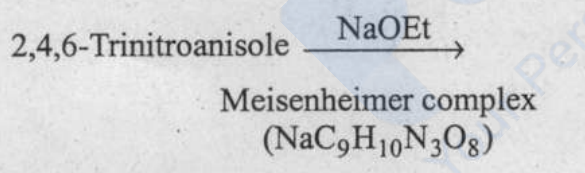
The number of $sp^3$ and $sp^2$ carbons, respectively, present in the Meisen- heimer complex, formed in the following reaction are