The major product formed in the following reaction sequence is 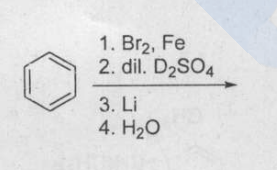
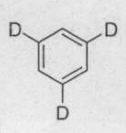
The given reaction sequence involves several steps that transform the reactant into the major product. Let's analyze each step:
- Bromination: The reaction starts with bromination of benzene using Br2 and Fe. Here, Fe acts as a catalyst to create the electrophile, Br+. The benzene ring reacts with Br+ to form bromobenzene:
The reaction is as follows:
- Deuteration: The bromobenzene undergoes deuteration using D2SO4, which replaces hydrogen atoms in the benzene ring with deuterium (D). This step does not affect the bromine atom already present on the ring.
- Metal-Halogen Exchange: Lithium (Li) is used to substitute the bromine atom with a lithium atom via a metal-halogen exchange reaction. This produces an organolithium compound.
- Protonation: Finally, the organolithium compound is treated with water (H2O), which results in the replacement of the lithium atom with a hydrogen atom, leading to the formation of deuterated benzene.
The major product of this reaction sequence is thus deuterated benzene.
Therefore, the correct answer is:
Important Questions from Aromatic compounds
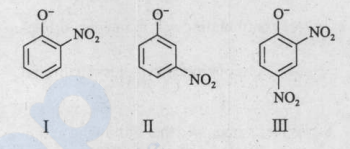
The correct decreasing order of basicity of the following anions is
The major product formed in the following reaction is
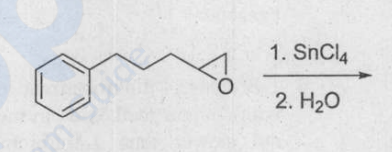
Consider the following statements :
1. 4-Chloro-3-nitroacetophenone reacts with sodium methoxide in methanol slower than 4-chloro-3- nitrotoluene
2. 4-Chloro-3-nitroacetophenone reacts with sodium methoxide in methanol faster than 4-chloro-3- nitrotoluene
3. 1-Bromo-2,4-dinitrobenzene reacts with sodium methoxide in metha- nol faster than 1,4-dibromo-2-nitro- benzene
4. 1-Bromo-2,4-dinitrobenzene reacts with sodium methoxide in metha- nol slower than 1,4-dibromo-2- nitrobenzeneWhich of the statements given above are correct?
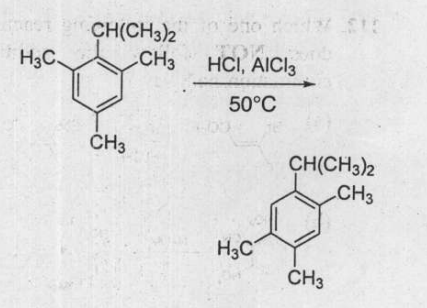
The most reasonable cyclohexadienyl cation intermediate involved in the mechanism of following isomerization reaction is
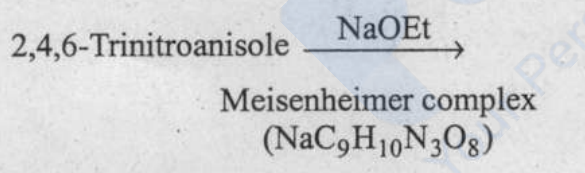
The number of $sp^3$ and $sp^2$ carbons, respectively, present in the Meisen- heimer complex, formed in the following reaction are