The most reasonable cyclohexadienyl cation intermediate involved in the mechanism of following isomerization reaction is 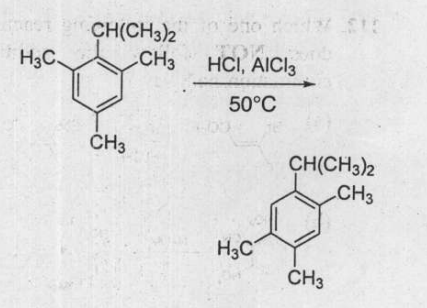
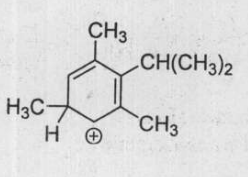
The isomerization reaction involves the rearrangement of a substituted benzene ring to form a different isomer under the presence of acid (HCl) and a Lewis acid catalyst (AlCl3). The reaction proceeds through the formation of a cyclohexadienyl cation intermediate, also known as a Wheland intermediate.
In this reaction, we can analyze the mechanism step-by-step:
- Protonation: The reaction begins with the protonation of the benzene ring's double bond by HCl, facilitated by the Lewis acid AlCl3. This leads to the formation of a positively charged cyclohexadienyl cation.
- Formation of the Cyclohexadienyl Cation: The most reasonable cation intermediate is formed where stabilization by adjacent groups occurs. The most stable option in this case, given the context, is the one where the positive charge is stabilized by hyperconjugation or resonance due to the presence of alkyl groups.
- Rearrangement and Deprotonation: The cation undergoes a rearrangement leading to the formation of the final product, which is an isomer of the starting compound.
Among the options provided, the correct cyclohexadienyl cation is the one where the positive charge can be stabilized effectively. This includes consideration of hyperconjugation and the inductive effect of the isopropyl group.
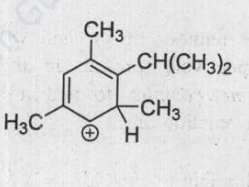
This structure is the most stable intermediate due to effective stabilization of the positive charge.
Important Questions from Aromatic compounds
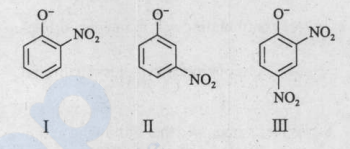
The correct decreasing order of basicity of the following anions is
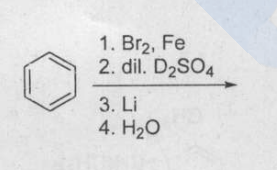
The major product formed in the following reaction sequence is
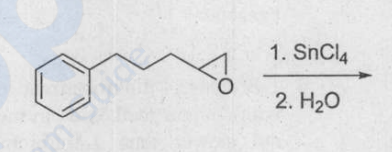
The major product formed in the following reaction is
Consider the following statements :
1. 4-Chloro-3-nitroacetophenone reacts with sodium methoxide in methanol slower than 4-chloro-3- nitrotoluene
2. 4-Chloro-3-nitroacetophenone reacts with sodium methoxide in methanol faster than 4-chloro-3- nitrotoluene
3. 1-Bromo-2,4-dinitrobenzene reacts with sodium methoxide in metha- nol faster than 1,4-dibromo-2-nitro- benzene
4. 1-Bromo-2,4-dinitrobenzene reacts with sodium methoxide in metha- nol slower than 1,4-dibromo-2- nitrobenzeneWhich of the statements given above are correct?
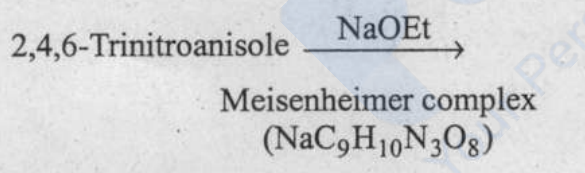
The number of $sp^3$ and $sp^2$ carbons, respectively, present in the Meisen- heimer complex, formed in the following reaction are