
Understanding Proton Decoupled $^{13}$C NMR
Proton decoupled $^{13}$C NMR spectroscopy simplifies spectra by removing spin-spin coupling between protons and carbons. This results in each unique carbon atom appearing as a single line (singlet), regardless of the number of attached protons. The number of signals directly corresponds to the number of chemically non-equivalent carbon environments in the molecule.
Analyzing Benzonitrile Structure
Benzonitrile has the chemical formula C7H5N. Its structure consists of a benzene ring substituted with a nitrile (-C≡N) group.
We need to identify the chemically distinct carbon atoms:
- Nitrile Carbon: The carbon atom within the -C≡N group. This is unique.
- Benzene Ring Carbons:
- The carbon attached directly to the nitrile group (Cipso). This is unique.
- The two carbons adjacent (ortho) to the ipso carbon (Cortho). Due to the molecule's symmetry, these two carbons are chemically equivalent.
- The two carbons meta to the ipso carbon (Cmeta). These two carbons are also chemically equivalent due to symmetry.
- The carbon opposite (para) to the ipso carbon (Cpara). This is unique.
Counting $^{13}$C NMR Signals
Based on the symmetry and the structure of benzonitrile, we can count the number of distinct carbon environments:
- Nitrile carbon (CN)
- Benzene ipso carbon (Cipso)
- Benzene ortho carbons (Cortho) - equivalent
- Benzene meta carbons (Cmeta) - equivalent
- Benzene para carbon (Cpara)
Therefore, there are 5 chemically non-equivalent carbon environments.
Conclusion
In a proton decoupled $^{13}$C NMR spectrum of benzonitrile, 5 distinct signals are expected, corresponding to the 5 chemically unique types of carbon atoms.
Important Questions from NMR Spectroscopy (1H and 13C)
In the $^1H$-NMR spectrum of the following molecule, the signal of proton $H_a$ appears as

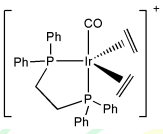
The $^1H$ NMR spectrum of the given iridium complex at room temperature gave a single signal at 2.6 ppm, and its $^{31}P$ NMR spectrum gave a single signal at 23.0 ppm. When the spectra were recorded at lower temperatures, both these signals split into a complex pattern. The intra-molecular dynamic processes shown by this molecule are
Compound K displayed a strong band at $1680 \text{ cm}^{-1}$ in its IR spectrum. Its $^1H$-NMR spectral data are as follows: $\delta$ (ppm) 7.30 (d, J = 7.2 Hz, 2H), 6.8 (d, J = 7.2 Hz, 2H), 3.8 (septet, J = 7.0 Hz, 1H), 2.2 (s, 3H), 1.9 (d, J = 7.0 Hz, 6H). The correct structure of compound K is
$^1H$ NMR spectrum of a mixture containing $CH_3Br$ ($x$ mol) and $(CH_3)_3CBr$ ($y$ mol) shows two singlets at 2.7 ppm and 1.8 ppm, with the relative ratio of 3:1 (integration value), respectively. The value of $x/y$ is ____________
(rounded off to the nearest integer)Consider the following $^1H$-NMR ($400$ MHz, DMSO-$d_6$) data of a compound:
$\delta$ in ppm: $3.85$ (s, $6H$), $6.73$ (t, $J = 2.2$ Hz, $1H$), $7.1$ (d, $J = 2.2$ Hz, $2H$), and $13.05$ (brs, $1H$).
The compound is


