
$^1H$ NMR spectrum of a mixture containing $CH_3Br$ ($x$ mol) and $(CH_3)_3CBr$ ($y$ mol) shows two singlets at 2.7 ppm and 1.8 ppm, with the relative ratio of 3:1 (integration value), respectively. The value of $x/y$ is ____________
(rounded off to the nearest integer)
NMR Spectrum Interpretation
The $^1H$ NMR spectrum provides information about the number and environment of hydrogen atoms in a molecule. The given spectrum shows two signals, indicating two distinct types of proton environments in the mixture.
- Signal 1: Observed at 2.7 ppm with a relative integration of 3.
- Signal 2: Observed at 1.8 ppm with a relative integration of 1.
Identifying Proton Sources
We need to correlate these signals to the protons in the two compounds: $CH_3Br$ (moles = $x$) and $(CH_3)_3CBr$ (moles = $y$).
- $CH_3Br$: Contains a methyl group ($CH_3$) with 3 protons. These protons are expected to resonate further downfield due to the electronegativity of the adjacent bromine atom.
- $(CH_3)_3CBr$: Contains a tert-butyl group ($(CH_3)_3C$), which has three equivalent methyl groups. This results in a total of 9 equivalent protons. These protons typically resonate at a higher field (lower ppm value) compared to $CH_3Br$.
Therefore:
- The signal at 2.7 ppm corresponds to the 3 protons of $CH_3Br$.
- The signal at 1.8 ppm corresponds to the 9 protons of $(CH_3)_3CBr$.
Calculating Molar Ratio ($x/y$)
The integration value of an NMR signal is directly proportional to the number of protons generating that signal.
- The total number of protons contributing to the 2.7 ppm signal is $3 \times x$ (3 protons per molecule times $x$ moles).
- The total number of protons contributing to the 1.8 ppm signal is $9 \times y$ (9 protons per molecule times $y$ moles).
The observed relative integration ratio is 3:1 for the 2.7 ppm signal ($CH_3Br$) and the 1.8 ppm signal ($(CH_3)_3CBr$), respectively. This ratio must equal the ratio of the total number of protons for each compound.
Setting up the ratio:
$ \frac{\text{Integration of Signal 1}}{\text{Integration of Signal 2}} = \frac{\text{Total Protons from } CH_3Br}{\text{Total Protons from } (CH_3)_3CBr} $
$ \frac{3}{1} = \frac{3x}{9y} $
Simplify the equation:
$ \frac{3}{1} = \frac{x}{3y} $
Now, solve for the molar ratio $x/y$:
$ 3 \times (3y) = 1 \times x $
$ 9y = x $
$ \frac{x}{y} = 9 $
Final Answer
The calculated value of $x/y$ is 9. Rounded to the nearest integer, the value remains 9.
Important Questions from NMR Spectroscopy (1H and 13C)
In the $^1H$-NMR spectrum of the following molecule, the signal of proton $H_a$ appears as

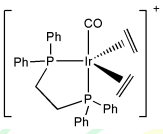
The $^1H$ NMR spectrum of the given iridium complex at room temperature gave a single signal at 2.6 ppm, and its $^{31}P$ NMR spectrum gave a single signal at 23.0 ppm. When the spectra were recorded at lower temperatures, both these signals split into a complex pattern. The intra-molecular dynamic processes shown by this molecule are
Compound K displayed a strong band at $1680 \text{ cm}^{-1}$ in its IR spectrum. Its $^1H$-NMR spectral data are as follows: $\delta$ (ppm) 7.30 (d, J = 7.2 Hz, 2H), 6.8 (d, J = 7.2 Hz, 2H), 3.8 (septet, J = 7.0 Hz, 1H), 2.2 (s, 3H), 1.9 (d, J = 7.0 Hz, 6H). The correct structure of compound K is
Consider the following $^1H$-NMR ($400$ MHz, DMSO-$d_6$) data of a compound:
$\delta$ in ppm: $3.85$ (s, $6H$), $6.73$ (t, $J = 2.2$ Hz, $1H$), $7.1$ (d, $J = 2.2$ Hz, $2H$), and $13.05$ (brs, $1H$).
The compound is- The $^{13}C$ NMR spectrum of acetone-$d_6$ has a signal at $30$ ppm as a septet in the intensity ratio


