
The $^1H$ NMR spectrum of the given iridium complex at room temperature gave a single signal at 2.6 ppm, and its $^{31}P$ NMR spectrum gave a single signal at 23.0 ppm. When the spectra were recorded at lower temperatures, both these signals split into a complex pattern. The intra-molecular dynamic processes shown by this molecule are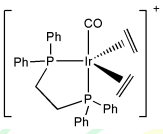
To understand the intra-molecular dynamic processes occurring in the iridium complex described, we will analyze the behavior of the 1H and 31P NMR signals with temperature changes.
At room temperature, the 1H NMR spectrum shows a single signal at 2.6 ppm, and the 31P NMR spectrum shows a single signal at 23.0 ppm. This indicates a high level of symmetry and rapid dynamic processes that average out the different environments of the protons and phosphorus atoms.
When the temperature is lowered, these signals split into more complex patterns. This is indicative of slowing down of the dynamic processes that leads to distinguishable environments for the protons and phosphorus atoms.
Let's analyze the options given:
- Berry pseudo-rotation and rotation of the ethylene units along the C=C axis: The Berry pseudo-rotation is typically observed in trigonal bipyramidal and square pyramidal complexes. However, the rotation along the C=C axis would not account for the full change observed, as the complex nature of the splitting indicates a more impactful rotation.
- Berry pseudo-rotation and propeller type rotation of the ethylene units along the Ir-alkene axis: The Berry pseudo-rotation allows rapid interconversion of axial and equatorial positions in trigonal bipyramidal systems. The propeller-type rotation along the Ir-alkene axis accounts for the complexity of patterns, as it leads to different positional arrangements among the substituents.
- Ray-Dutt twist and rotation of the ethylene units along the C=C axis: The Ray-Dutt twist is more specific to specific types of octahedral complexes and does not typify this kind of complex rearrangement patterns in this iridium complex.
- Ray-Dutt twist and propeller type rotation of the ethylene units along the Ir-alkene axis: Although propeller rotation can contribute to signal complexity, the Ray-Dutt twist doesn't address the specific dynamics of the given structure effectively.
From the analysis, the correct intra-molecular dynamic processes are:
Berry pseudo-rotation and propeller type rotation of the ethylene units along the Ir-alkene axis.
These processes result in diverse positional changes in the iridium complex, leading to the observed NMR signal behaviors at lowered temperatures.
Important Questions from NMR Spectroscopy (1H and 13C)
In the $^1H$-NMR spectrum of the following molecule, the signal of proton $H_a$ appears as

Compound K displayed a strong band at $1680 \text{ cm}^{-1}$ in its IR spectrum. Its $^1H$-NMR spectral data are as follows: $\delta$ (ppm) 7.30 (d, J = 7.2 Hz, 2H), 6.8 (d, J = 7.2 Hz, 2H), 3.8 (septet, J = 7.0 Hz, 1H), 2.2 (s, 3H), 1.9 (d, J = 7.0 Hz, 6H). The correct structure of compound K is
$^1H$ NMR spectrum of a mixture containing $CH_3Br$ ($x$ mol) and $(CH_3)_3CBr$ ($y$ mol) shows two singlets at 2.7 ppm and 1.8 ppm, with the relative ratio of 3:1 (integration value), respectively. The value of $x/y$ is ____________
(rounded off to the nearest integer)Consider the following $^1H$-NMR ($400$ MHz, DMSO-$d_6$) data of a compound:
$\delta$ in ppm: $3.85$ (s, $6H$), $6.73$ (t, $J = 2.2$ Hz, $1H$), $7.1$ (d, $J = 2.2$ Hz, $2H$), and $13.05$ (brs, $1H$).
The compound is- The $^{13}C$ NMR spectrum of acetone-$d_6$ has a signal at $30$ ppm as a septet in the intensity ratio


