
In the $^1H$-NMR spectrum of the following molecule, the signal of proton $H_a$ appears as
To determine the splitting pattern of proton \(H_a\) in the given molecule in its \( ^1H \)-NMR spectrum, we will use the N+1 rule, where N is the number of hydrogen neighbors.
In the molecule, proton \(H_a\) is adjacent to four equivalent deuterium atoms (D). Deuterium generally does not contribute to splitting as it behaves differently from hydrogen in NMR spectroscopy. Hence, only hydrogen atoms usually cause splitting.
However, if we consider any hydrogens typically in similar scenarios where the adjacent carbon has hydrogen atoms, the protons would generally split based on the N+1 rule. This means if \(H_a\) had been adjacent to four freely-rotating hydrogen atoms instead of deuterium, we would expect splitting into N+1 peaks, i.e., 4+1 = 5 peaks, which forms a quintet.
Thus, since this setup shows no real hydrogen coupling, the conceptual answer based on typical organic molecules involving similar structures would be that \(H_a\) would appear as a quintet if hydrogen were interacting.
Correct Answer: Quintet
Important Questions from NMR Spectroscopy (1H and 13C)
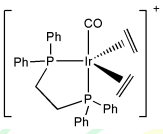
The $^1H$ NMR spectrum of the given iridium complex at room temperature gave a single signal at 2.6 ppm, and its $^{31}P$ NMR spectrum gave a single signal at 23.0 ppm. When the spectra were recorded at lower temperatures, both these signals split into a complex pattern. The intra-molecular dynamic processes shown by this molecule are
Compound K displayed a strong band at $1680 \text{ cm}^{-1}$ in its IR spectrum. Its $^1H$-NMR spectral data are as follows: $\delta$ (ppm) 7.30 (d, J = 7.2 Hz, 2H), 6.8 (d, J = 7.2 Hz, 2H), 3.8 (septet, J = 7.0 Hz, 1H), 2.2 (s, 3H), 1.9 (d, J = 7.0 Hz, 6H). The correct structure of compound K is
$^1H$ NMR spectrum of a mixture containing $CH_3Br$ ($x$ mol) and $(CH_3)_3CBr$ ($y$ mol) shows two singlets at 2.7 ppm and 1.8 ppm, with the relative ratio of 3:1 (integration value), respectively. The value of $x/y$ is ____________
(rounded off to the nearest integer)Consider the following $^1H$-NMR ($400$ MHz, DMSO-$d_6$) data of a compound:
$\delta$ in ppm: $3.85$ (s, $6H$), $6.73$ (t, $J = 2.2$ Hz, $1H$), $7.1$ (d, $J = 2.2$ Hz, $2H$), and $13.05$ (brs, $1H$).
The compound is- The $^{13}C$ NMR spectrum of acetone-$d_6$ has a signal at $30$ ppm as a septet in the intensity ratio


