
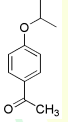
Compound K displayed a strong band at $1680 \text{ cm}^{-1}$ in its IR spectrum. Its $^1H$-NMR spectral data are as follows: $\delta$ (ppm) 7.30 (d, J = 7.2 Hz, 2H), 6.8 (d, J = 7.2 Hz, 2H), 3.8 (septet, J = 7.0 Hz, 1H), 2.2 (s, 3H), 1.9 (d, J = 7.0 Hz, 6H). The correct structure of compound K is
1. IR Spectroscopy Analysis
The strong absorption band at $1680 \text{ cm}^{-1}$ in the IR spectrum is characteristic of a carbonyl group (C=O). This suggests the presence of a ketone or conjugated aldehyde functional group within compound K.
2. $^1$H-NMR Spectroscopy Analysis
The $^1$H-NMR data provides detailed information about the proton environments:
- Aromatic Protons: Signals at $\delta$ 7.30 (doublet, 2H, $J=7.2$ Hz) and $\delta$ 6.8 (doublet, 2H, $J=7.2$ Hz) indicate a para-disubstituted benzene ring. The two doublets suggest two pairs of equivalent aromatic protons adjacent to each other.
- Methyl Group: A singlet signal at $\delta$ 2.2 (3H) points to a methyl group ($\text{CH}_3$) without adjacent non-equivalent protons. This is consistent with an acetyl group ($-\text{COCH}_3$) attached to the aromatic ring.
- Isopropyl Group: Signals at $\delta$ 3.8 (septet, 1H, $J=7.0$ Hz) and $\delta$ 1.9 (doublet, 6H, $J=7.0$ Hz) are characteristic of an isopropyl group $(-\text{CH}(\text{CH}_3)_2)$. The septet corresponds to the methine proton ($-\text{CH}-$), and the doublet corresponds to the six protons of the two methyl groups ($(\text{CH}_3)_2$). The matching coupling constants ($J=7.0$ Hz) confirm this assignment.
3. Structure Determination
Combining the spectral evidence:
- The IR data indicates a carbonyl group.
- The NMR data reveals a para-disubstituted aromatic ring, a methyl group, and an isopropyl group.
- The most plausible structure fitting all these features is 4-Isopropylacetophenone. This structure contains:
- A carbonyl group (ketone) consistent with the IR peak.
- An acetyl group ($-\text{COCH}_3$), which explains the methyl singlet (though the chemical shift is slightly lower than typical).
- An isopropyl group $(-\text{CH}(\text{CH}_3)_2)$ attached to the aromatic ring, explaining the septet and doublet signals.
- The para-substitution pattern matches the aromatic proton signals.
Option C represents the structure of 4-Isopropylacetophenone.
4. Conclusion
The spectral data, including the IR absorption and the detailed $^1$H-NMR signals (aromatic protons, methyl singlet, isopropyl septet and doublet), strongly support the structure shown in Option C.
Important Questions from NMR Spectroscopy (1H and 13C)
In the $^1H$-NMR spectrum of the following molecule, the signal of proton $H_a$ appears as

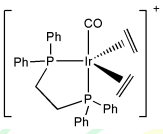
The $^1H$ NMR spectrum of the given iridium complex at room temperature gave a single signal at 2.6 ppm, and its $^{31}P$ NMR spectrum gave a single signal at 23.0 ppm. When the spectra were recorded at lower temperatures, both these signals split into a complex pattern. The intra-molecular dynamic processes shown by this molecule are
$^1H$ NMR spectrum of a mixture containing $CH_3Br$ ($x$ mol) and $(CH_3)_3CBr$ ($y$ mol) shows two singlets at 2.7 ppm and 1.8 ppm, with the relative ratio of 3:1 (integration value), respectively. The value of $x/y$ is ____________
(rounded off to the nearest integer)Consider the following $^1H$-NMR ($400$ MHz, DMSO-$d_6$) data of a compound:
$\delta$ in ppm: $3.85$ (s, $6H$), $6.73$ (t, $J = 2.2$ Hz, $1H$), $7.1$ (d, $J = 2.2$ Hz, $2H$), and $13.05$ (brs, $1H$).
The compound is- The $^{13}C$ NMR spectrum of acetone-$d_6$ has a signal at $30$ ppm as a septet in the intensity ratio


