
Acetone-d6 $^{13}C$ NMR Signal Analysis
This question concerns the 13C NMR spectrum of acetone-$d_6$, specifically the signal characteristics of its methyl carbons. Acetone-$d_6$ has the chemical formula $(CD_3)_2CO$.
Deuterium Coupling Mechanism
The signal observed in the 13C NMR spectrum is from the carbon atoms located in the $CD_3$ groups. These carbon nuclei interact (couple) with the deuterium ($D$) nuclei directly bonded to them.
Deuterium ($D$) possesses a nuclear spin quantum number of $I=1$.
Calculating Signal Multiplicity
The number of lines in a split NMR signal is determined by the number of equivalent coupling nuclei ($n$) and their spin quantum number ($I$), using the formula: $ \text{Number of lines} = 2nI + 1 $
In acetone-$d_6$, each methyl carbon is bonded to $n=3$ deuterium atoms. Since $I=1$ for deuterium, the calculation is: $ 2 \times 3 \times 1 + 1 = 7 $
A signal split into 7 lines is referred to as a septet, matching the observation stated in the question.
Intensity Ratio Interpretation
The relative intensities of the lines within the septet follow a specific pattern determined by the statistical distribution of nuclear spin states during the coupling interaction.
For the coupling of a 13C nucleus to three equivalent deuterium nuclei ($n=3, I=1$), the resulting septet exhibits an intensity ratio of $1:3:6:7:6:3:1$.
Final Signal Description
Therefore, the 13C NMR spectrum of acetone-$d_6$ features a signal around 30 ppm, characterized as a septet with the intensity ratio $1:3:6:7:6:3:1$, due to coupling with the three attached deuterium atoms.
Important Questions from NMR Spectroscopy (1H and 13C)
In the $^1H$-NMR spectrum of the following molecule, the signal of proton $H_a$ appears as

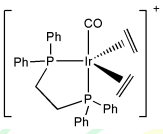
The $^1H$ NMR spectrum of the given iridium complex at room temperature gave a single signal at 2.6 ppm, and its $^{31}P$ NMR spectrum gave a single signal at 23.0 ppm. When the spectra were recorded at lower temperatures, both these signals split into a complex pattern. The intra-molecular dynamic processes shown by this molecule are
Compound K displayed a strong band at $1680 \text{ cm}^{-1}$ in its IR spectrum. Its $^1H$-NMR spectral data are as follows: $\delta$ (ppm) 7.30 (d, J = 7.2 Hz, 2H), 6.8 (d, J = 7.2 Hz, 2H), 3.8 (septet, J = 7.0 Hz, 1H), 2.2 (s, 3H), 1.9 (d, J = 7.0 Hz, 6H). The correct structure of compound K is
$^1H$ NMR spectrum of a mixture containing $CH_3Br$ ($x$ mol) and $(CH_3)_3CBr$ ($y$ mol) shows two singlets at 2.7 ppm and 1.8 ppm, with the relative ratio of 3:1 (integration value), respectively. The value of $x/y$ is ____________
(rounded off to the nearest integer)Consider the following $^1H$-NMR ($400$ MHz, DMSO-$d_6$) data of a compound:
$\delta$ in ppm: $3.85$ (s, $6H$), $6.73$ (t, $J = 2.2$ Hz, $1H$), $7.1$ (d, $J = 2.2$ Hz, $2H$), and $13.05$ (brs, $1H$).
The compound is


