
Consider the following $^1H$-NMR ($400$ MHz, DMSO-$d_6$) data of a compound:
$\delta$ in ppm: $3.85$ (s, $6H$), $6.73$ (t, $J = 2.2$ Hz, $1H$), $7.1$ (d, $J = 2.2$ Hz, $2H$), and $13.05$ (brs, $1H$).
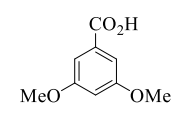
The compound is
Analyzing 1H NMR Data for Structure Elucidation
The provided $^1H$-NMR data is analyzed to determine the structure of the compound. We examine each signal based on its chemical shift ($\delta$), multiplicity (s=singlet, t=triplet, d=doublet, brs=broad singlet), coupling constant ($J$), and integration (number of protons).
Signal Interpretation
- $\delta$ 3.85 (s, 6H): This signal indicates the presence of two equivalent methyl groups. The singlet multiplicity suggests they are not coupled to any nearby protons. This is characteristic of two methoxy ($-\text{OCH}_3$) groups, likely attached to an aromatic ring symmetrically.
- $\delta$ 6.73 (t, 1H, $J = 2.2$ Hz): A triplet integrating for one proton, coupled with a $J$ value of $2.2$ Hz. This suggests a proton influenced by two equivalent neighboring protons.
- $\delta$ 7.1 (d, 2H, $J = 2.2$ Hz): A doublet integrating for two protons, coupled with the same $J$ value of $2.2$ Hz. This indicates two equivalent protons coupled to a single proton. The triplet and doublet pattern with the same coupling constant often arises from meta-coupling in symmetrically substituted aromatic rings.
- $\delta$ 13.05 (brs, 1H): A highly deshielded broad singlet for one proton. This is strongly indicative of an acidic proton, most commonly a carboxylic acid ($-\text{COOH}$) proton.
Structure Identification
Combining these observations:
- The presence of two $-\text{OCH}_3$ groups (6H singlet) and a $-\text{COOH}$ group (1H broad singlet at 13.05 ppm) points towards a substituted benzoic acid.
- The aromatic signals (1H triplet and 2H doublet) suggest a specific substitution pattern on the benzene ring.
Let's consider the structure of 3,5-Dimethoxybenzoic acid:
- It has two equivalent $-\text{OCH}_3$ groups at positions 3 and 5.
- It has a $-\text{COOH}$ group at position 1.
- The protons at positions 2 and 6 (equivalent) are ortho to the $-\text{COOH}$ group and meta to the $-\text{OCH}_3$ groups.
- The proton at position 4 is para to the $-\text{COOH}$ group and ortho to both $-\text{OCH}_3$ groups.
This structure matches the observed NMR data:
- The two $-\text{OCH}_3$ groups give the singlet at $\delta$ 3.85 (6H).
- The $-\text{COOH}$ proton gives the broad singlet at $\delta$ 13.05 (1H).
- The aromatic protons H-2 and H-6 (2H) appear as a doublet around $\delta$ 7.1, coupled to H-4.
- The aromatic proton H-4 (1H) appears as a triplet around $\delta$ 6.73, coupled to H-2 and H-6.
- The coupling constant $J = 2.2$ Hz is typical for meta-coupling in such systems.
Therefore, the compound is 3,5-Dimethoxybenzoic acid.
Important Questions from NMR Spectroscopy (1H and 13C)
In the $^1H$-NMR spectrum of the following molecule, the signal of proton $H_a$ appears as

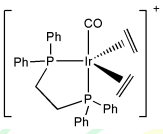
The $^1H$ NMR spectrum of the given iridium complex at room temperature gave a single signal at 2.6 ppm, and its $^{31}P$ NMR spectrum gave a single signal at 23.0 ppm. When the spectra were recorded at lower temperatures, both these signals split into a complex pattern. The intra-molecular dynamic processes shown by this molecule are
Compound K displayed a strong band at $1680 \text{ cm}^{-1}$ in its IR spectrum. Its $^1H$-NMR spectral data are as follows: $\delta$ (ppm) 7.30 (d, J = 7.2 Hz, 2H), 6.8 (d, J = 7.2 Hz, 2H), 3.8 (septet, J = 7.0 Hz, 1H), 2.2 (s, 3H), 1.9 (d, J = 7.0 Hz, 6H). The correct structure of compound K is
$^1H$ NMR spectrum of a mixture containing $CH_3Br$ ($x$ mol) and $(CH_3)_3CBr$ ($y$ mol) shows two singlets at 2.7 ppm and 1.8 ppm, with the relative ratio of 3:1 (integration value), respectively. The value of $x/y$ is ____________
(rounded off to the nearest integer)- The $^{13}C$ NMR spectrum of acetone-$d_6$ has a signal at $30$ ppm as a septet in the intensity ratio


