
Question
The major product formed in the reaction of quinoline with potassium amide (KNH$_2$) in liquid ammonia is
The correct answer is
Understanding Quinoline Reaction with Potassium Amide
The reaction between quinoline and potassium amide ($KNH_2$) in liquid ammonia is a classic example of the Chichibabin reaction. This reaction involves nucleophilic aromatic substitution on the heterocyclic ring.
Chichibabin Reaction Mechanism and Quinoline Reactivity
- Nucleophile: Potassium amide ($KNH_2$) dissociates in liquid ammonia to provide the amide ion ($NH_2^-$), a strong nucleophile and base.
- Substrate: Quinoline contains a benzene ring fused to a pyridine ring. The pyridine ring is electron-deficient due to the electronegativity of the nitrogen atom, making it susceptible to nucleophilic attack.
- Regioselectivity: Nucleophilic attack primarily occurs at the C2 and C4 positions of the pyridine ring. In quinoline, the C2 position is generally more reactive towards the amide ion than the C4 position.
- Mechanism Steps:
- The amide ion ($NH_2^-$) attacks the electron-deficient C2 position of quinoline.
- This forms a negatively charged intermediate (a sigma complex).
- Subsequent elimination of a hydride ion ($H^-$) restores aromaticity. The hydride ion is typically oxidized or reacts further.
- Protonation (often during workup) yields the amino derivative.
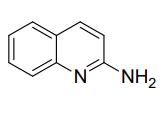
- Major Product: The attack at the C2 position is favored, leading to the formation of 2-aminoquinoline as the major product. While some 4-aminoquinoline might form, it is usually the minor product.
Identifying the Correct Product
Based on the reaction mechanism and regioselectivity:
- Option 1 shows 4-aminoquinoline.
- Option 2 correctly depicts 2-aminoquinoline, the expected major product.
- Option 3 shows 3-aminoquinoline, which is not formed via this reaction.
- Option 4 shows 8-aminoquinoline, which is also not the primary product.
Therefore, the major product formed is 2-aminoquinoline.
Was this answer helpful?
Important Questions from Heterocyclic Chemistry
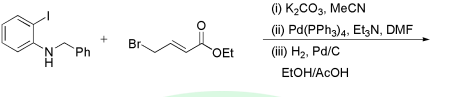
The major product formed in the following reaction sequences is
- The reaction(s) that yield(s) 2-methylquinoline as the major product is (are)
- Which one of the following bioreactor configurations is the basis for a trickling biological filter?
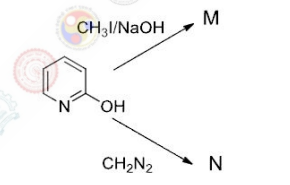
The major products M and N formed in the following reactions are
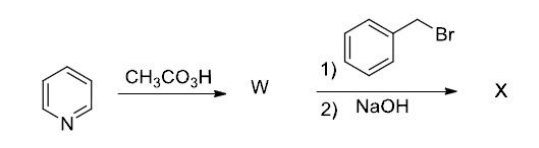
The structures of the major products W and X in the following synthetic scheme are
Need Expert Advice?


