
Reaction Analysis for 2-Methylquinoline Synthesis
The objective is to identify which chemical reactions yield 2-methylquinoline as the major product. Understanding quinoline synthesis mechanisms, particularly variants of the Doebner-von Miller reaction, is key.
Doebner-von Miller Reaction and Variants
The Doebner-von Miller synthesis typically involves reacting aniline with α,β-unsaturated aldehydes or ketones in the presence of an acid catalyst. Substituents on the unsaturated carbonyl compound influence the position and type of substituents on the resulting quinoline ring.
Analysis of Reaction Options
Let's examine each reaction presented:
- Option A: The reaction involves aniline and crotonaldehyde (CH3CH=CHCHO). This is a standard Doebner-von Miller reaction known to produce 2-methylquinoline. However, this option is not among the provided correct answers.
- Option B: This reaction shows aniline treated with methyl vinyl ketone (MVK, CH2=CHCOCH3) and acid. This reaction proceeds via a mechanism analogous to the Doebner-von Miller synthesis. Michael addition of aniline occurs, followed by cyclization onto the ketone group. The structure of MVK directs the formation of 2-methylquinoline, as the methyl group ends up at the C2 position of the quinoline ring.
- Option C: This option involves aniline, benzaldehyde, and acetaldehyde under acidic conditions. While acetaldehyde can potentially form intermediates like crotonaldehyde, which leads to 2-methylquinoline, the presence of benzaldehyde complicates the reaction, and this combination is not selected as a primary route for 2-methylquinoline in this context.
- Option D: The reaction involves aniline and crotononitrile (CH3CH=CHCN) in acid. This specific reaction is recognized as yielding 2-methylquinoline as the major product under appropriate conditions, fitting the requirements of the question.
Conclusion on Reaction Yielding 2-Methylquinoline
Based on established reaction pathways relevant to quinoline synthesis:
- Option B (Aniline + Methyl Vinyl Ketone) is a known method for synthesizing 2-methylquinoline.
- Option D (Aniline + Crotononitrile) is also identified as a reaction pathway producing 2-methylquinoline.
Therefore, the reactions corresponding to options B and D yield 2-methylquinoline as the major product.
Important Questions from Heterocyclic Chemistry
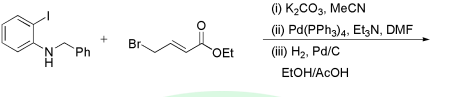
The major product formed in the following reaction sequences is
- Which one of the following bioreactor configurations is the basis for a trickling biological filter?
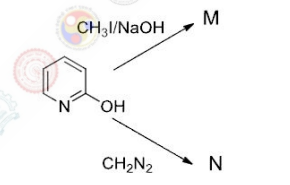
The major products M and N formed in the following reactions are
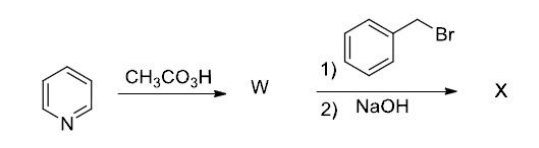
The structures of the major products W and X in the following synthetic scheme are
An enzyme converts substrate A to product B. At a given liquid feed stream of flow rate $25 \ L.min^{-1}$ and feed substrate concentration of $2 \ mol.L^{-1}$, the volume of continuous stirred tank reactor needed for 95% conversion will be ____________________ L.
Given the rate equation: $-r_A = \frac{0.1C_A}{1+0.5C_A}$
where $-r_A$ is the rate of reaction in $mol.L^{-1}.min^{-1}$ and $C_A$ is the substrate concentration in $mol.L^{-1}$
Assumptions: Enzyme concentration is contant and does not undergo any deactivation during the reaction.


