
The major products M and N formed in the following reactions are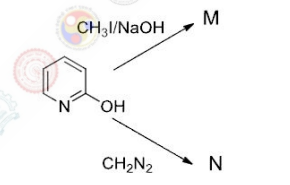
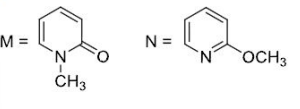
To determine the major products M and N from the given reaction, we need to analyze the reagents used:
- The first reaction involves CH3I and NaOH with the aromatic compound. This is typically an O-methylation reaction. The hydroxyl group (-OH) on the pyridine ring reacts with CH3I to form an O-alkylated product. Therefore, product M is a methoxy derivative:
- The second reaction involves CH2N2, which is diazomethane. This reagent commonly converts alcohols into ethers or can cause diazo coupling. However, in this context, for pyridones, CH2N2 can form a methylated ether at the N-position of pyridones, leading to an N-methylation.
Thus, product N is an N-methylated derivative of the original pyridone.
By analyzing each step, we find that the correct products M and N should look like in the image provided above. Therefore, the correct structure is shown as follows:
Both reactions proceeded via nucleophilic substitution involving methoxide (CH3O-) and nitrogen from the diazomethane attacking the respective sites.
Conclusion: The correct answer is the structure corresponding to the image with data-src-id="696f859b5f38c9e57cfb2276", indicating both O- and N-methylation of the starting compound.
Important Questions from Heterocyclic Chemistry
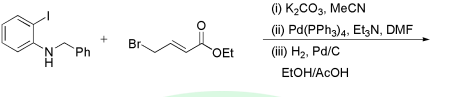
The major product formed in the following reaction sequences is
- The reaction(s) that yield(s) 2-methylquinoline as the major product is (are)
- Which one of the following bioreactor configurations is the basis for a trickling biological filter?
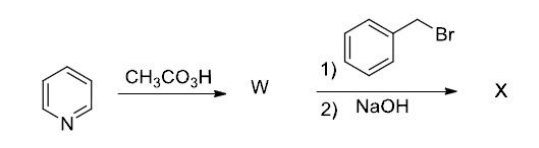
The structures of the major products W and X in the following synthetic scheme are
An enzyme converts substrate A to product B. At a given liquid feed stream of flow rate $25 \ L.min^{-1}$ and feed substrate concentration of $2 \ mol.L^{-1}$, the volume of continuous stirred tank reactor needed for 95% conversion will be ____________________ L.
Given the rate equation: $-r_A = \frac{0.1C_A}{1+0.5C_A}$
where $-r_A$ is the rate of reaction in $mol.L^{-1}.min^{-1}$ and $C_A$ is the substrate concentration in $mol.L^{-1}$
Assumptions: Enzyme concentration is contant and does not undergo any deactivation during the reaction.


