
The major product formed in the following reaction sequences is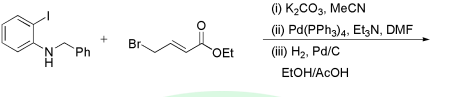
To find the major product of the given reaction sequence, let's analyze each step involved in the process:
The reaction involves:
- Base-Promoted Cross-Coupling Reaction: The first step involves the reaction of a bromide compound with K2CO3 and acetonitrile (MeCN) as the solvent. This is a typical setup for a Pd-catalyzed cross-coupling reaction. The role of the base here is to neutralize the acid formed during the coupling process.
- Palladium-Catalyzed Reaction: In the presence of Pd(PPh3)4 and Et3N with DMF as a solvent, the reaction proceeds via a Suzuki-Miyaura coupling. This step enables the formation of a C-C bond between the aryl iodide and the brominated compound.
- Hydrogenation: The final step is a reduction using H2 over Pd/C catalyst in a mixture of ethanol and acetic acid, which is likely aimed at reducing any unsaturated systems or functional groups that can be hydrogenated.
The experimental setup suggests that the major transformation occurs via coupling and reduction:
- The aryl iodide and the bromide undergo coupling, resulting in a new carbon-carbon bond.
- The reduction step would typically impact alkenes, alkynes, or carbonyl groups, leading to saturation or to alcohol, respectively.
Given these transformations, the major product formed can be rationalized. Let's consider the available options:

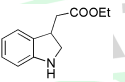

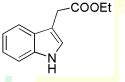
The correct option is:
- The correct product should depict the formation of the C-C bond followed by correct reduction of the appropriate functional group.
Therefore, the major product is:
Important Questions from Heterocyclic Chemistry
- The reaction(s) that yield(s) 2-methylquinoline as the major product is (are)
- Which one of the following bioreactor configurations is the basis for a trickling biological filter?
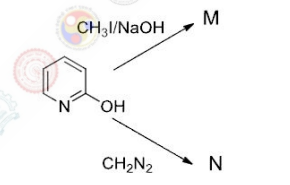
The major products M and N formed in the following reactions are
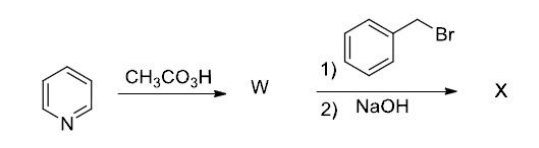
The structures of the major products W and X in the following synthetic scheme are
An enzyme converts substrate A to product B. At a given liquid feed stream of flow rate $25 \ L.min^{-1}$ and feed substrate concentration of $2 \ mol.L^{-1}$, the volume of continuous stirred tank reactor needed for 95% conversion will be ____________________ L.
Given the rate equation: $-r_A = \frac{0.1C_A}{1+0.5C_A}$
where $-r_A$ is the rate of reaction in $mol.L^{-1}.min^{-1}$ and $C_A$ is the substrate concentration in $mol.L^{-1}$
Assumptions: Enzyme concentration is contant and does not undergo any deactivation during the reaction.


