
Lanthanide Color Origin
The color observed in lanthanide ions ($Ln^{3+}$) in aqueous solutions arises from electronic transitions between different energy levels within their partially filled $4f$ orbitals. These are known as $f$-$f$ transitions. Ions with empty ($f^0$), half-filled ($f^7$), or completely filled ($f^{14}$) $f$ subshells generally do not exhibit color because these transitions are either impossible or very weak.
Ion Electronic Configurations and Color
Let's examine the electron configurations of the given lanthanide ions:
- $La^{3+}$: Lanthanum ($La$) has atomic number 57. $La^{3+}$ has the configuration $4f^0$. With no electrons in the $f$ subshell, it cannot exhibit $f$-$f$ transitions and is colorless.
- $Eu^{3+}$: Europium ($Eu$) has atomic number 63. $Eu^{3+}$ has the configuration $4f^6$. The $f$ subshell is partially filled, allowing for $f$-$f$ transitions, resulting in color (typically pink or red in solution).
- $Gd^{3+}$: Gadolinium ($Gd$) has atomic number 64. $Gd^{3+}$ has the configuration $4f^7$. Although the $f$ subshell is half-filled and contains unpaired electrons, the transitions in $Gd^{3+}$ are often very weak, leading to ions that are essentially colorless or very faintly colored in solution.
- $Lu^{3+}$: Lutetium ($Lu$) has atomic number 71. $Lu^{3+}$ has the configuration $4f^{14}$. The $f$ subshell is completely filled. Similar to $La^{3+}$, it lacks the possibility for $f$-$f$ transitions and is colorless.
Conclusion on Colored Ion
Based on the electronic configurations, $Eu^{3+}$ is the lanthanide ion among the choices that exhibits color in aqueous solution due to its partially filled $4f$ subshell ($4f^6$).
Important Questions from Antigen Antibody Reaction
- The pair(s) of lanthanide ions whose ground state term symbols have same spin multiplicity (2S+1) and orbital angular momentum (L), but different spin-orbit coupling (J) is(are)
(Given: Atomic number: Nd = 60; Pm = 61; Ho = 67; Er = 68) The interaction between an antigen (Ag) and a single-chain antibody (Ab) was studied using Scatchard analysis. The result is shown below.
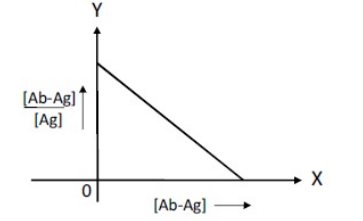
The affinity of interaction and the total concentration of antibody, respectively, can be determined from
Generally, the coordination number and the nature of the electronic absorption band ($f\rightarrow f$transition) of lanthanide (III) ion in their complexes are, respectively,
- The calculated and observed magnetic moments differ considerably for an aqua complex of a lanthanide(III) ion as a result of low lying states of high J. The ion, among the following, is
- The correct electronic configuration and spin only magnetic moment of $Gd^{3+}$ (at.no. 64) are


